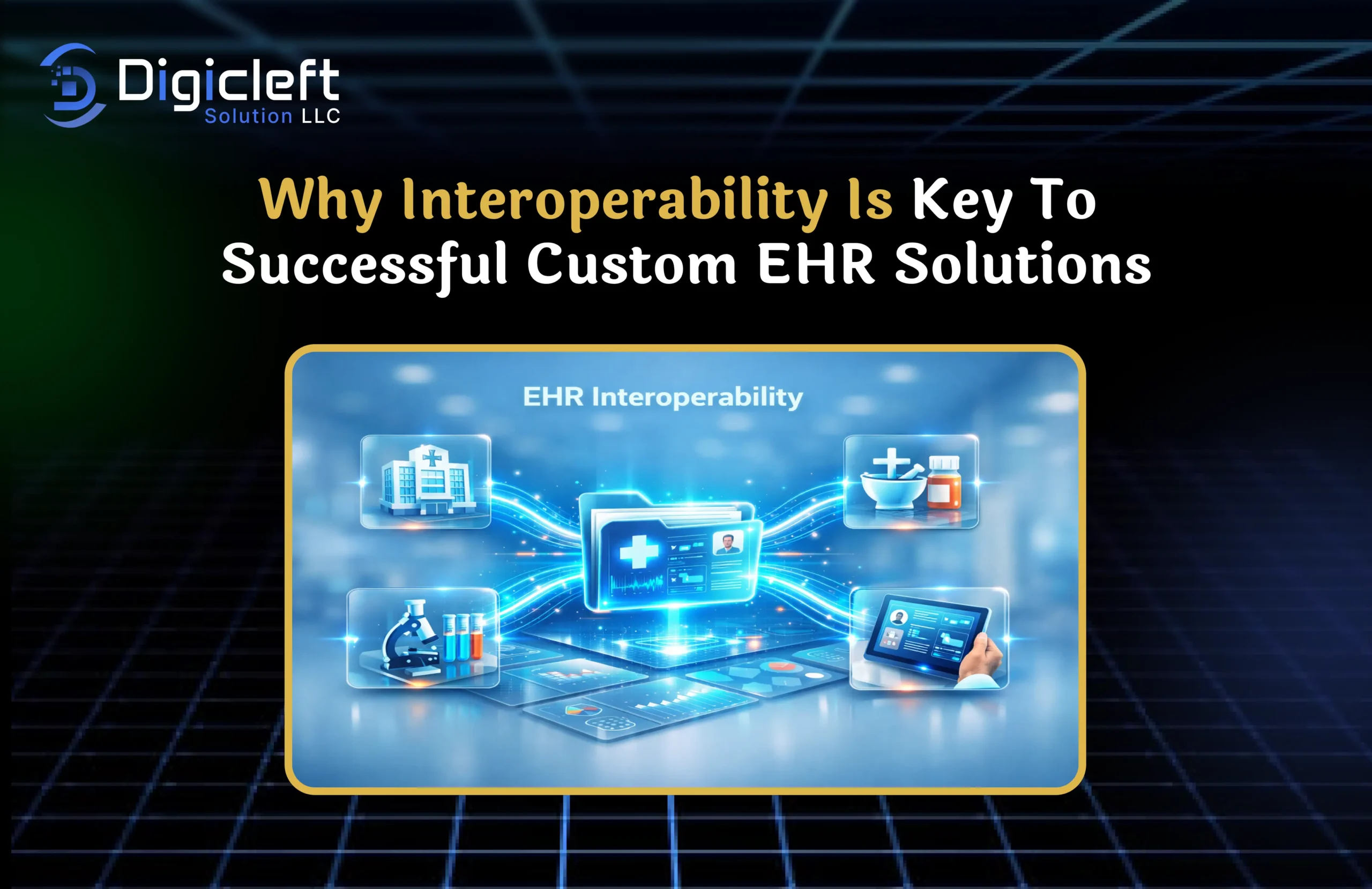
Healthcare doesn’t suffer from a lack of data. It suffers from data that refuses to talk to itself. Hospitals, clinics, labs, pharmacies, and insurance providers all hold valuable information but it’s trapped inside disconnected systems.
The result? Doctors waste time searching for patient history, nurses re-enter the same data repeatedly, and patients are stuck explaining their story again and again.
This is exactly why interoperability has become the backbone of successful custom EHR solutions. Without it, even the most beautifully designed EHR Solutions is just another digital filing cabinet. With it, an EHR becomes a living system that actually supports care.
And yes this is where smart, flexible platforms like Digicleft Solutions come into the picture.
What Is Interoperability in Healthcare?
At its core, interoperability is the ability of different systems to exchange, understand, and use data seamlessly.
But in healthcare, it goes deeper than simply transferring files.
Technical Interoperability
This is the foundation. It ensures systems can connect and transmit data using APIs, messaging standards, and secure networks.
Think of it like roads between cities. Without roads, no matter how advanced the vehicles are, nothing moves.
Semantic Interoperability
Semantic interoperability ensures that shared data actually means the same thing across systems. If one system records “MI” and another expects “Myocardial Infarction,” both must interpret it identically.
Without this clarity, clinical decisions can be based on dangerous assumptions.
Organizational Interoperability
This is the human side policies, workflows, and governance that allow data sharing across departments and organizations.
Technology alone can’t solve interoperability. Alignment does.
Why Custom EHR Solutions Are Gaining Momentum
Off-the-shelf EHR Solutions systems try to serve everyone and as a result, they rarely serve anyone well.
Custom EHR solutions are built around:
- Specific clinical workflows
- Unique reporting requirements
- Regional compliance needs
- Integration with existing tools
Healthcare providers want systems that adapt to them not the other way around. Interoperability is what makes that flexibility real.
The Cost of Poor Interoperability in EHR Systems
Data Silos and Fragmented Care
Patient data gets scattered across labs, imaging centers, specialists, and hospitals. Clinicians see only fragments, not the full picture.
That’s how errors happen.
Clinician Burnout and Workflow Chaos
Manual data entry. Duplicate records. Constant system switching. Poor interoperability turns clinicians into data clerks and burnout follows quickly.
Compliance and Reporting Challenges
Regulatory reporting, audits, and insurance claims become painful when data lives in silos. Time meant for patient care gets swallowed by administrative work.
How Interoperability Transforms Custom EHR Solutions
Seamless Data Exchange Across Systems
Interoperable custom EHR Solutions automatically pull data from labs, pharmacies, imaging systems, wearables, and even external hospitals.
No retyping. No chasing PDFs.
Real-Time Clinical Decision Support
Connected systems allow decision-support tools to analyze complete patient data in real time.
- Smarter alerts
- More accurate diagnoses
- Faster interventions
Better Patient Engagement and Outcomes
Patients benefit too. Interoperable EHRs support:
- Patient portals
- Telemedicine
- Remote monitoring
When patients can see their complete health journey in one place, trust grows.
Interoperability Standards Powering Modern EHRs
HL7 and FHIR Explained Simply
HL7 has been around for decades, but FHIR (Fast Healthcare Interoperability Resources) is the modern favorite.
FHIR uses APIs and web-friendly formats, making integration faster and more flexible ideal for custom EHR development.
APIs as the Backbone of Integration
APIs allow systems to connect like Lego blocks. API-first custom EHRs are scalable and future-proof by design.
Custom vs Off-the-Shelf EHRs: The Interoperability Gap
Most off-the-shelf EHRs promise integration but deliver limitations.
Custom EHRs:
- Integrate only what you need
- Avoid unnecessary modules
- Support evolving workflows
Interoperability isn’t an add-on it’s built into the DNA.
Security and Privacy in Interoperable EHR Systems
A common myth is that interoperability weakens security. In reality, well-designed interoperable systems are often more secure.
- Role-based access
- Encrypted data exchange
- Audit trails
Custom EHRs can meet strict compliance standards while still sharing data safely.
Why Healthcare Providers Choose Digicleft Solutions
Healthcare organizations don’t just want software they want clarity.
Digicleft Solutions builds custom EHR systems where interoperability is the foundation, not an afterthought. The result is software that fits real workflows, integrates seamlessly, and actually gets used.
The Future of Interoperable EHR Systems
AI, predictive analytics, and personalized medicine all depend on connected data. Interoperability unlocks the future of healthcare technology.
Conclusion: Interoperability Is No Longer Optional
Interoperability is no longer a “nice to have.” It’s the difference between digital clutter and digital care.
Custom EHR solutions succeed when they connect people, data, and decisions seamlessly. With interoperability, healthcare finally moves forward together.
FAQs
1. Why is interoperability critical in custom EHR solutions?
It enables seamless data sharing, improving care quality, efficiency, and clinical decisions.
2. How does interoperability reduce clinician burnout?
By eliminating duplicate data entry, reducing system switching, and streamlining workflows.
3. Is interoperability only for large hospitals?
No. Clinics, specialty practices, and telehealth providers benefit just as much.
4. Are interoperable EHRs secure?
Yes, when built correctly using modern standards and encryption.
5. Can existing systems be integrated into custom EHRs?
Absolutely. With the right APIs and middleware, even legacy systems can be connected.