What Is Agentic AI?
Artificial intelligence has been evolving for decades, but something fundamentally different is happening right now. The conversation has shifted from AI that simply answers questions to AI that acts, decides, and executes tasks independently. This new paradigm is called Agentic AI, and it is rapidly redefining how digital systems work.
Think about traditional AI tools for a moment. They wait for instructions. You type a prompt, they respond. You ask for a report, they generate it. That’s helpful but still reactive.
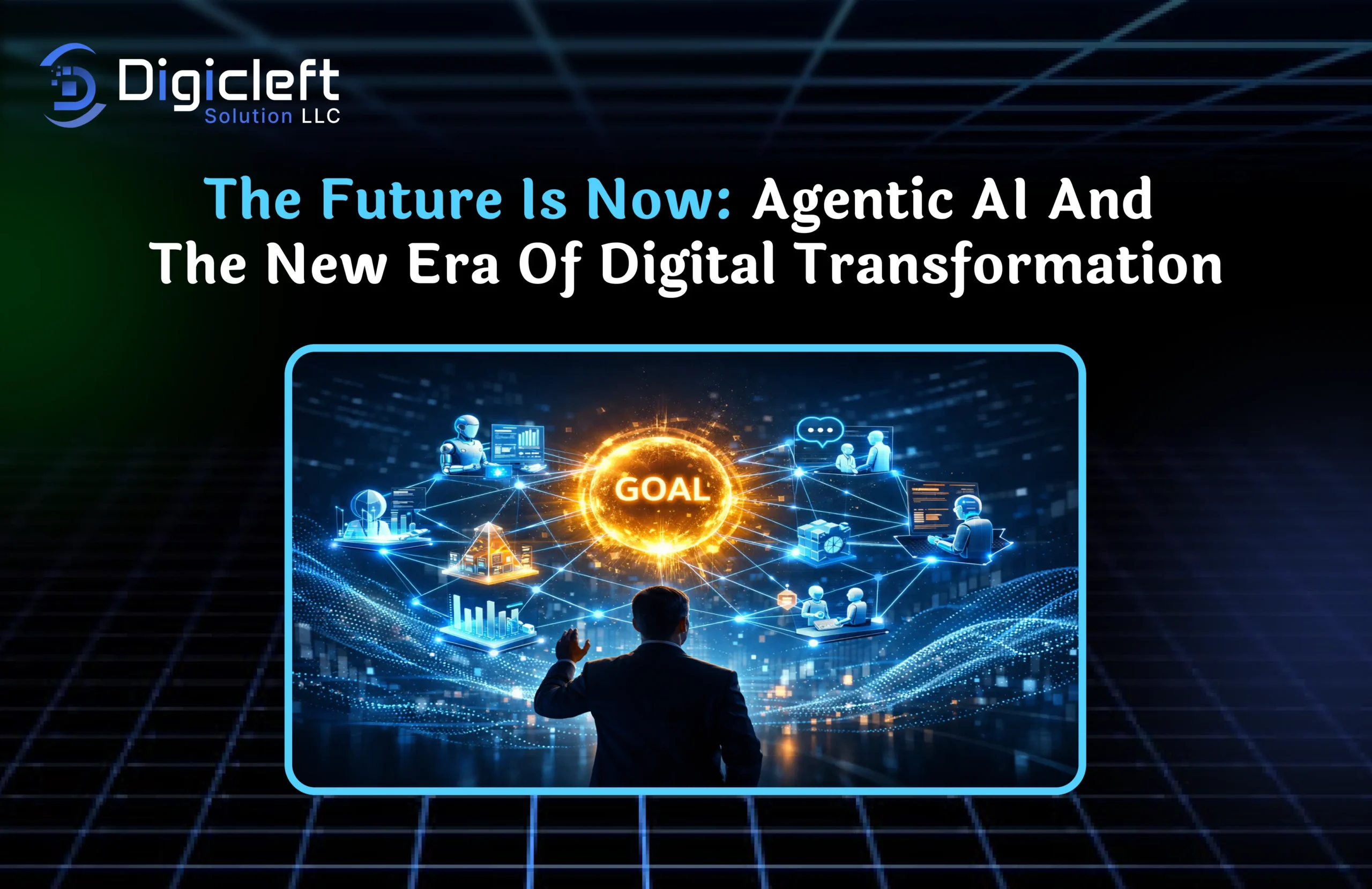
Agentic AI flips the script. Instead of waiting for commands, these systems plan tasks, make decisions, and take action on their own to achieve a defined goal.
Researchers describe agentic AI as systems capable of autonomous reasoning and multi-step decision making, allowing them to perform complex workflows without constant human input.
In simple terms, agentic AI behaves less like software and more like a digital colleague. Give it an objective such as researching competitors, analyzing data, and drafting a report and it can break that goal into smaller tasks and complete them independently.
Businesses today are drowning in data, workflows are becoming more complex, and customer expectations are rising. Agentic AI offers a way to handle this complexity by automating not just tasks but entire decision processes.
Companies like Digicleft Solutions are already exploring how agent-based systems can reshape enterprise operations, helping organizations automate strategic workflows instead of just repetitive tasks.
The result? Digital transformation is no longer about adding tools it’s about building autonomous systems that drive results.
From Traditional AI to Autonomous Agents
To understand the significance of agentic AI, it helps to look at the evolution of artificial intelligence over the past few years.
Early automation focused on rule-based systems. These systems could execute predefined workflows but failed whenever the situation changed.
Then came machine learning and predictive analytics. These tools became better at identifying patterns, making predictions, and assisting humans with decisions but they still required constant supervision.
Agentic AI represents the third stage of this evolution: systems that can plan, reason, and act.
Open-source systems such as AutoGPT demonstrate how AI agents can break a large goal into smaller tasks and execute them independently.
The Evolution of AI
| AI Stage | Capability | Human Involvement |
|---|---|---|
| Traditional Automation | Rule-based workflows | High |
| Generative AI | Content creation and analysis | Moderate |
| Agentic AI | Autonomous decision-making and execution | Low |
Instead of a marketer manually analyzing data and creating campaigns, an AI agent could:
- Analyze audience behavior
- Generate campaign strategies
- Launch advertisements
- Optimize performance
Analysts predict massive growth in this field. By 2026, around 40% of enterprise applications are expected to include task-specific AI agents, compared with less than 5% in 2025.
Why Agentic AI Is Transforming Digital Business
The Shift from Tools to Decision Makers
For years, digital transformation revolved around software platforms CRM systems, analytics dashboards, automation tools, and cloud infrastructure. Each tool improved productivity but still relied heavily on human involvement.
Agentic AI changes this dynamic completely.
Instead of juggling dozens of platforms, organizations can deploy AI agents that coordinate those tools automatically.
An agent might monitor customer behavior, identify opportunities, launch marketing campaigns, and optimize them in real time.
This shift turns technology from a passive tool into an active participant in business strategy.
Real-Time Intelligence and Automation
Speed has always been a competitive advantage in business. The faster a company can analyze information and act on it, the more opportunities it can capture.
Agentic AI dramatically accelerates this process.
Examples include:
- A supply chain agent detects delays and reroutes shipments automatically.
- A cybersecurity agent identifies suspicious activity and blocks threats instantly.
- A marketing agent adjusts campaigns based on real-time customer behavior.
These decisions happen continuously and automatically.
Core Technologies Powering Agentic AI
Large Language Models and Reasoning Systems
At the heart of agentic AI lies a powerful technology: Large Language Models (LLMs). These models enable machines to understand human language, generate text, and reason about complex tasks.
In agentic systems, LLMs do far more than generate content. They act as decision engines.
- Analyze datasets
- Run simulations
- Send emails
- Manage software systems
Multi-Agent Architectures
One AI agent is powerful. A network of AI agents working together is transformative.
Multi-agent systems assign different roles to different agents:
- Research Agent – gathers market insights
- Strategy Agent – builds recommendations
- Execution Agent – launches campaigns
Together, they operate like a digital team.
Benefits Businesses Can Expect
Speed, Efficiency, and Scalability
- Faster execution
- Reduced operational costs
- Improved accuracy
- Unlimited scalability with cloud infrastructure
Innovation and Competitive Advantage
Agentic AI does not just automate tasks it frees humans to focus on creativity and strategy. Teams can spend less time on repetitive work and more time on innovation.
Challenges and Ethical Considerations
Governance, Security, and Trust
Autonomous systems raise important questions about responsibility. If an AI agent makes a decision affecting customers or finances, who is accountable?
Organizations are investing in AI monitoring systems and governance frameworks to address these concerns.
Implementation Challenges
Experts predict that over 40% of agentic AI projects could be cancelled by 2027 due to unclear ROI, governance challenges, and technical complexity.
Preparing for the Agentic Future
Companies preparing for the agentic AI era should focus on:
- Building strong data infrastructure
- Integrating AI with existing platforms
- Establishing governance frameworks
- Training teams to collaborate with AI systems
Conclusion
Agentic AI marks the beginning of a new chapter in digital transformation. Instead of tools that simply assist humans, we now have systems capable of reasoning, planning, and executing tasks independently.
Businesses that embrace this shift will operate faster, scale more efficiently, and innovate more freely.
The future of work will not be humans versus machines it will be humans working alongside intelligent agents that amplify productivity and unlock new possibilities.
FAQs
1. What is Agentic AI in simple terms?
Agentic AI refers to artificial intelligence systems that can plan, decide, and execute tasks independently to achieve specific goals.
2. How is Agentic AI different from Generative AI?
Generative AI produces content based on prompts, while Agentic AI autonomously completes multi-step tasks and workflows.
3. Which industries will benefit most from Agentic AI?
Industries such as finance, logistics, healthcare, e-commerce, and customer service will see major benefits.
4. Is Agentic AI safe for businesses?
Yes, when implemented with strong governance, monitoring systems, and clear operational boundaries.
5. Will Agentic AI replace human jobs?
Instead of replacing humans entirely, Agentic AI will automate repetitive tasks and allow people to focus on strategy and creativity.