
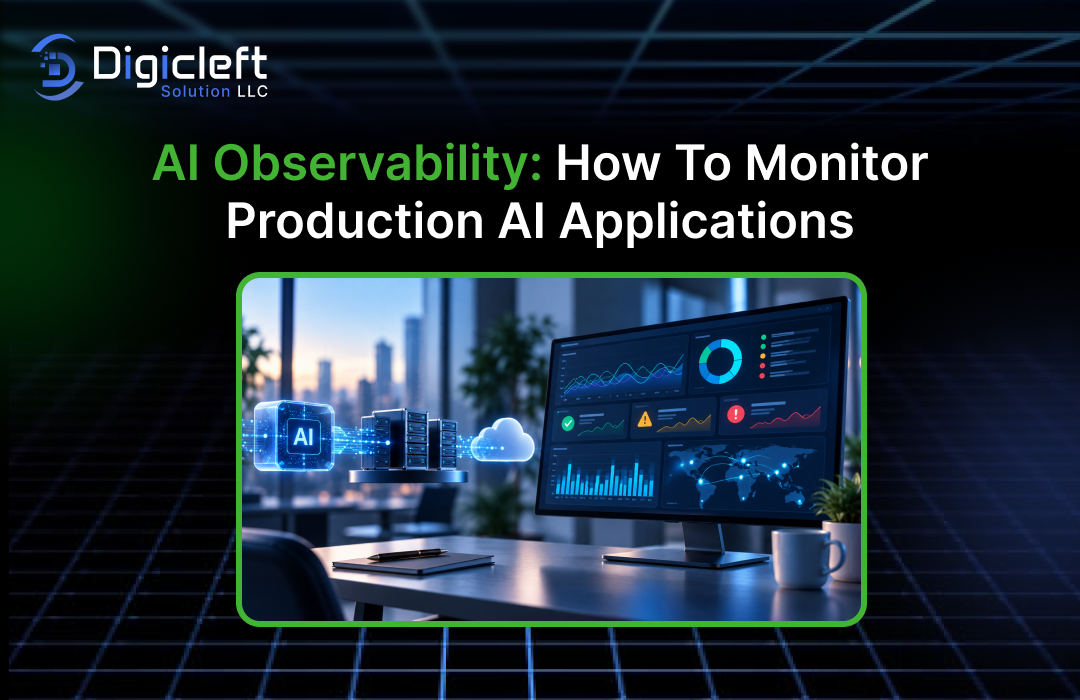
Understanding AI Observability: Monitoring AI Applications in Production
AI observability is the practice of monitoring and analyzing AI-specific telemetry to understand how large language models behave in real production environments. Unlike traditional monitoring, it evaluates prompts, responses, token usage, retrieval quality, hallucinations, and model performance.
Why Traditional Monitoring Is No Longer Enough
Modern AI applications are probabilistic. Two users can ask similar questions and receive different responses, making debugging much more difficult than conventional software systems.
| Traditional App | AI Application |
|---|---|
| Server crash | Hallucinated answer |
| Timeout | Slow model inference |
| Database error | Retrieval failure |
| Memory leak | Context window overflow |
| High CPU | Excessive token usage |
Monitoring vs AI Observability
| Monitoring | AI Observability |
|---|---|
| Detects outages | Explains AI behavior |
| Tracks latency | Tracks quality + latency |
| Infrastructure focused | Model + prompt focused |
| Static dashboards | End-to-end tracing |
| Alerts on failures | Diagnoses root causes |
Why Production AI Needs Observability
- Detect hallucinated responses
- Prevent prompt injection attacks
- Monitor knowledge base drift
- Reduce latency issues
- Control inference costs
- Improve customer experience
The Five Pillars of AI Observability
1. Logs, Metrics & Traces
Capture prompts, errors, token usage, latency, and end-to-end workflow traces.
2. Prompt & Response Evaluation
- Faithfulness
- Relevance
- Correctness
- Toxicity
- Groundedness
- User satisfaction
3. Drift Monitoring
| Drift Type | Example |
|---|---|
| Data Drift | Customer language changes |
| Knowledge Drift | Documentation becomes outdated |
| Prompt Drift | Template modifications |
| Behavior Drift | Model version changes |
| Embedding Drift | Search relevance declines |
4. Cost & Token Analytics
- Tokens per request
- Prompt length
- Completion length
- Cache utilization
- Cost per conversation
5. Safety & Governance
- Audit trails
- Sensitive data detection
- Bias monitoring
- Compliance logging
- Model version history
AI System Architecture
A production-ready AI system collects telemetry from every interaction including user prompts, retrieved documents, tool calls, model selection, latency, token consumption, evaluation scores, and user feedback.
Key Metrics Every Team Should Track
| Metric | Purpose |
|---|---|
| Response Latency | Measure speed |
| Throughput | Traffic stability |
| Error Rate | Reliability |
| Token Usage | Cost optimization |
| Faithfulness | Reduce hallucinations |
| User Rating | Customer satisfaction |
Best Practices
- Capture every production interaction.
- Run automated quality evaluations.
- Detect anomalies early.
- Collect human feedback.
- Continuously improve prompts.
- Deploy updates safely.
Popular AI Observability Tools
| Platform | Best For |
|---|---|
| Langfuse | Open-source LLM tracing |
| Arize AI | Model evaluation |
| Datadog | Enterprise monitoring |
| Weights & Biases | ML lifecycle |
| Helicone | Token analytics |
| OpenTelemetry | Standardized telemetry |
Conclusion
AI observability is the operational foundation of every production AI application. By combining logs, traces, prompt evaluation, drift detection, safety monitoring, and token analytics, organizations can build AI systems that are reliable, trustworthy, and cost-effective.
Frequently Asked Questions
1.What is AI observability?
It is the practice of monitoring AI models using logs, metrics, traces, prompt evaluations, and token analytics.
2.Why is it different from traditional monitoring?
Traditional monitoring focuses on infrastructure, while AI observability evaluates model quality and decision-making.
3.What metrics matter most?
Latency, token usage, faithfulness, relevance, accuracy, user satisfaction, and retrieval quality.
4.Is OpenTelemetry useful?
Yes. It provides standardized tracing across prompts, tool calls, retrieval, and model inference.
5.Can AI observability reduce costs?
Yes. Monitoring prompt efficiency, caching, and token consumption helps optimize inference expenses.