Introduction to AI Agents and AI Chatbots
Artificial intelligence is transforming the way businesses interact with customers, manage daily operations, and provide digital experiences.
From responding to customer inquiries to overseeing complex tasks, AI tools are becoming essential in how modern organizations function. If you’ve been researching AI solutions for your business, you may have come across two terms that seem similar: AI agents and AI chatbots. While they share some common technologies, their roles are quite different.
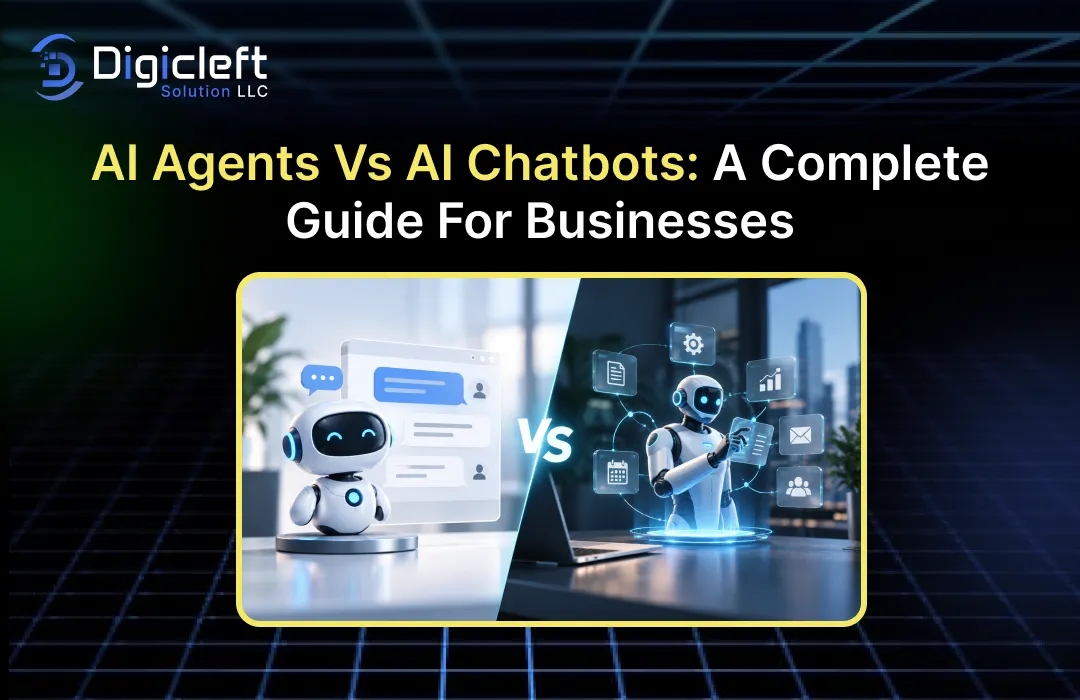
An AI chatbot can act as a helpful conversational assistant. It can answer questions, explain services, suggest products, and help visitors navigate your website.
An AI agent, by contrast, functions more like a digital colleague, working to achieve a specific goal by using approved tools, interacting with software, and completing several steps. This difference is important because answering a question and completing a task are very different responsibilities.
According to a Shopify guide published in August 2026, McKinsey’s 2025 AI research found that 62% of surveyed respondents were experimenting with AI agents, while 23% reported scaling an agentic AI system within their enterprise.
These figures reflect reported testing and implementation, not assured business outcomes. Nonetheless, they show why businesses are taking notice of this technology.
In this guide, we will explore the differences between AI agents and AI chatbots, compare their capabilities, examine real-world business applications, and discuss how to select the best approach for your organization.
We will also look at how effective website design and Digicleft Solutions fit into a more comprehensive digital strategy.
What Is an AI Chatbot?
An AI chatbot is a software program designed to communicate with users through text or voice. It uses artificial intelligence to understand questions, interpret conversational context, and provide relevant answers.
Businesses often use chatbots on websites, messaging apps, customer support platforms, and mobile applications.
Imagine someone visiting your website at 11:30 p.m. They might want to know if your company delivers to their city, how much a specific service costs, or whether weekend support is available. If your team is unavailable, a chatbot can still offer useful information if it has access to accurate business data.
Modern AI chatbots go beyond the basic question-and-answer systems many people remember.
They can understand various ways people phrase the same question, maintain context in a conversation, and retrieve information from approved knowledge sources. However, their effectiveness depends on how they are set up and what information and tools they can access.
How AI Chatbots Work
Most modern AI chatbots combine language-processing capabilities with a conversational interface.
When a user sends a message, the system interprets the message, considers available context, and generates a response. Based on the setup, it may also fetch information from company documents, product databases, or customer support resources.
For example, a visitor might ask, “Do you have any affordable website packages for a small business?” A chatbot could explain the available packages, describe their features, and direct the user to a consultation form.
If it’s connected to current pricing data, it could even provide more detailed information.
Some chatbots rely on predefined conversations, while others use large language models to handle a wider range of questions.
A chatbot can also be linked to tools, which means the line between chatbots and agents isn’t always clear. The key question is whether the system is primarily built for conversation or designed to plan and carry out more complex tasks.
Business Benefits of AI Chatbots
One of the greatest benefits of chatbots is their ability to handle repetitive customer questions.
Instead of having employees repeatedly explain delivery policies, service choices, or account procedures, businesses can make this information available through an automated conversational interface.
Chatbots also make websites more user-friendly for visitors who prefer asking questions rather than navigating through multiple pages.
A potential customer may not know whether to look under “Services,” “Solutions,” or “Pricing.” A conversational assistant can help them find what they need without requiring them to understand the website’s entire structure.
Other benefits include:
- Providing customer support outside of regular business hours.
- Helping visitors discover relevant products and services.
- Collecting initial details from potential leads.
- Guiding customer questions to the correct department.
- Supporting customer service teams during busy times.
The true benefit lies in making information more accessible. A chatbot should not just be a small feature on a website; it should address a real customer issue.
What Is an AI Agent?
An AI agent is a system powered by artificial intelligence that is designed to achieve a specific goal by analyzing information, making decisions, and using tools to complete tasks.
Depending on its permissions and setup, it can interact with business software, access records, update data, or manage several actions within a workflow.
Imagine a customer wanting to change an appointment. A chatbot might explain the rescheduling policy and offer a link to the booking page.
An AI agent connected to the scheduling system could check available times, find the relevant appointment, update the booking after approval, and send a confirmation message.
The difference is not just that one tool is more advanced than the other. It is that the agent is meant to move from understanding a request to achieving a result.
How AI Agents Work
An AI agent typically starts with a goal, such as preparing a report, handling a support request, or checking inventory levels.
It analyzes the task, identifies the necessary steps, and uses approved tools or integrations to carry them out. It may then review the results to determine if further actions are needed.
For example, consider a simple inventory process. A company wants to track stock levels and generate replenishment suggestions when stock reaches a certain level.
An AI agent could gather inventory data, identify items that need attention, check supplier details, and create a purchase recommendation for review.
More advanced systems might perform approved actions automatically, but this authority should never be assumed.
An agent’s abilities rely on its integrations, access rights, operating rules, and safety measures.
A helpful way to think about an AI agent is as a digital coordinator. It can connect different parts of a process, but it still requires clear objectives, accurate information, and boundaries to prevent unintended actions.
Business Benefits of AI Agents
AI agents can be beneficial in business processes that involve multiple connected steps and require more than just a conversation.
They can reduce repetitive coordination, assist employees in working with information across different applications, and support workflows that would otherwise need manual switching between systems.
For example, a sales team might spend a lot of time gathering information before contacting a potential client.
A well-configured AI agent could collect approved company data, organize relevant details, and create a draft briefing for a salesperson to review.
The employee is still responsible for making the final decision and managing the customer relationship.
AI agents can also support internal operations. Depending on their setup, they might help reconcile data, classify incoming requests, prepare reports, or direct tasks to the appropriate team.
However, automation does not automatically mean cost savings or improved results.
Businesses must assess the quality of completed tasks, integration costs, handling exceptions, and the level of human supervision needed.
AI Agents vs AI Chatbots: Key Differences
The easiest way to understand the difference between AI agents and AI chatbots is to look at the purpose of each system.
A chatbot is primarily designed for communication. An AI agent is built to achieve a goal by making a series of decisions and taking actions.
Modern systems often combine both approaches, so the distinction relies on the actual capabilities of the system rather than the name used in a product.
| Feature | AI Chatbot | AI Agent |
|---|---|---|
| Primary Purpose | Answer questions and support conversations | Complete defined tasks and workflows |
| Typical Interaction | User asks; system responds | User or system sets a goal; agent works toward it |
| Autonomy | Usually limited to conversation and configured functions | Can make bounded decisions within an approved workflow |
| Tool Access | Optional; often focused on information retrieval | Often uses tools and integrations to perform tasks |
| Workflow Complexity | Usually simple or moderately complex interactions | Often multi-step processes |
| Common Use | FAQs, product information, initial support | Scheduling, workflow coordination, record updates |
| Human Involvement | Useful for escalation and difficult questions | Important for approvals, exceptions, and sensitive actions |
| Main Concern | Response accuracy and customer experience | Accuracy, permissions, action safety, and oversight |
Capabilities, Autonomy, and Integration
The most important difference is how the system handles the next step.
Suppose a customer asks, “Where is my order?” A chatbot with access to order tracking can retrieve the shipment status and explain it.
An agent might be configured to investigate a delayed shipment, check the relevant delivery information, prepare a support case, and notify the appropriate team.
Both systems may use language models, databases, and APIs. What separates them is the workflow they are designed and authorized to perform.
Autonomy is also not an all-or-nothing feature. An agent may be allowed to gather information independently but require human approval before sending a customer communication or issuing a refund.
A chatbot may have access to a limited action, such as creating a support ticket, without becoming a fully autonomous workflow agent.
For businesses, this means comparing actual product capabilities is more useful than relying on labels such as “advanced AI” or “autonomous assistant.”
Real-World Business Applications
AI chatbots and AI agents can support a wide range of business functions, from customer communication to internal operations.
The right application depends on the process, the quality of available data, and the consequences of an incorrect action.
Customer Service, Sales, and Marketing
Customer service is a natural starting point for chatbot adoption. Many customer questions are repetitive, and people often want immediate access to basic information.
A chatbot can explain return policies, provide product details, help visitors navigate support resources, or collect information before transferring a request to an employee.
AI agents can support customer service when a request requires several coordinated actions.
For example, a service workflow might involve checking an order, reviewing an approved policy, preparing a return request, and routing it for authorization.
An agent can coordinate these steps if it has the necessary integrations and permissions.
Sales teams can use chatbots to answer preliminary questions and help website visitors identify relevant services.
Agents can assist behind the scenes by organizing lead information, preparing meeting briefs, or updating CRM records under approved rules.
Marketing teams may use chatbots to help visitors explore content or understand product features.
Agents can assist with repetitive campaign operations, such as preparing draft reports or organizing performance data. Human review remains important for brand messaging, customer targeting, and decisions that affect advertising spend.
Operations, Finance, and HR
In operations, AI agents may help coordinate workflows that involve several systems.
An agent could collect information from an internal database, identify incomplete records, and prepare a list of issues for an operations employee.
With suitable authorization, it may also perform narrowly defined updates.
Finance teams can explore AI assistance for document classification, transaction categorization, report preparation, and exception identification.
However, financial transfers, approvals, tax decisions, and other consequential activities require appropriate controls and professional oversight.
Human resources teams can use chatbots to answer employee questions about leave policies, onboarding procedures, or internal resources.
AI agents may help organize onboarding tasks, prepare documentation, and notify relevant departments when a new employee joins.
In every department, the guiding principle is the same: automate repetitive work where the process is clear, while keeping people involved when judgment, accountability, or sensitive decisions matter.
AI Agents vs AI Chatbots: Which Should Your Business Choose?
Choosing between an AI chatbot and an AI agent starts with understanding the problem you want to solve.
It is easy to become distracted by impressive demonstrations, but a sophisticated tool is not automatically the right fit for every organization.
If your main issue is responding to repeated customer questions, assisting visitors in finding information, or enhancing access to your services, a chatbot could be a suitable solution.
It can offer a simple starting point without requiring your company to overhaul several internal processes.
If your challenge involves multiple steps across different business applications, an AI agent might be a better option to explore.
Examples include managing changes to appointments, gathering data from various systems, or supporting inventory management workflows.
These kinds of projects need careful attention to system integration, user permissions, and handling exceptions.
| Business Requirement | Potential Approach |
|---|---|
| Answer common website questions | AI chatbot |
| Help visitors explore services | AI chatbot |
| Collect initial lead information | Chatbot or hybrid system |
| Prepare a multi-source business report | AI agent |
| Coordinate an approved workflow | AI agent |
| Combine customer conversation with backend task completion | Chatbot + AI agent |
A practical approach is to start with a clearly defined use case, determine how success will be measured, and test the system with real-world examples.
Track factors such as response accuracy, task completion rates, customer satisfaction, employee workload, and the cost of maintaining the solution.
Businesses should also consider whether their existing software supports the necessary integrations.
An AI agent that cannot reliably access the systems it needs may create more problems than it solves.
Creating Engaging and Intuitive Websites for Maximum Impact
AI tools are just one part of a successful digital experience. Your website remains the main place where customers learn about your business, explore your services, and decide whether to take the next step.
A website can include advanced AI features and still frustrate visitors if the navigation is confusing, the pages load slowly, or the information is hard to understand.
That is why creating engaging and intuitive websites for maximum impact begins with understanding what users need and designing around those needs.
Start by making the website’s purpose clear. When someone lands on your homepage, they should quickly understand what your business offers, who it serves, and where to go next.
Use straightforward navigation, readable typography, consistent page layouts, and clear calls to action. Visitors should not have to solve a puzzle to find your contact information.
Content also plays a key role. Instead of filling pages with generic marketing language, explain your services in practical terms.
Answer common questions, describe your process, and provide useful examples that help customers understand what working with your business might involve.
An AI chatbot can support this experience by helping visitors find information or navigate service options.
An AI agent may assist with specific backend workflows, such as creating a lead record or managing a consultation request, once the necessary integrations and approvals are in place.
How Digicleft Solution Fits into Your Digital Strategy
For businesses looking to strengthen their online presence, Digicleft Solution can be part of a broader discussion about website design, digital experiences, and AI-supported customer interactions.
When evaluating a digital partner, focus on the specific services offered and how they align with your business goals.
A useful website project should consider more than just appearance. It should address usability, mobile responsiveness, performance, accessibility, content structure, search visibility, and the customer journey.
If you are considering working with Digicleft Solution, clarify the project requirements before choosing specific technologies.
Discuss whether your website needs a chatbot for customer questions, a workflow agent for internal tasks, or simply a clearer and more effective website experience.
A sensible project plan might begin with a website and customer journey review, followed by improvements to page structure, content, navigation, and conversion paths.
AI features can then be introduced where they address a clearly identified need.
The goal is not to include AI everywhere. It is to create a digital experience that helps people find information, understand your offerings, and complete the actions they came to perform.
Challenges and Security Considerations
AI agents and chatbots introduce practical challenges that businesses should address before deployment.
A chatbot may provide incorrect information, misinterpret a question, or fail to recognize when a human employee should take over.
An AI agent can introduce additional risks because it may interact with business systems and perform actions.
Security is especially important when agents have access to customer records, internal applications, or operational tools.
A September 2026 discussion on enterprise AI security highlighted concerns about excessive permissions and the management of machine identities.
This reinforces the need to treat AI systems as controlled participants in business processes, rather than granting them unrestricted access.
Foundational Safeguards
- Limit permissions: Give each system access only to the information and actions required for its task.
- Protect sensitive data: Define what information can be accessed, processed, and retained.
- Require approvals: Use human authorization for sensitive or consequential actions.
- Monitor performance: Review errors, unexpected actions, and changes in system behavior.
- Plan for failure: Provide clear escalation routes and ways to stop or reverse actions where possible.
Another challenge is data quality. If an AI system relies on outdated service information, inconsistent customer records, or incomplete documentation, its output may be unreliable.
Before automating a process, businesses should understand how the underlying information is maintained.
Responsible adoption also means being transparent with customers about AI interactions, offering human assistance when appropriate, and measuring whether the technology genuinely improves the experience.
The Future of AI Agents and Chatbots
The distinction between AI agents and chatbots is becoming less rigid as conversational systems gain access to more tools and workflow capabilities.
A customer-facing chatbot may increasingly serve as the interface through which people request tasks, while connected agents handle selected activities behind the scenes.
For businesses, this could mean a more unified digital experience. A customer might begin by asking a question, receive personalized information, and then request an action without switching between several applications.
Whether that experience works well will depend on reliable integrations, accurate information, thoughtful design, and appropriate permissions.
Recent enterprise discussions also emphasize the importance of moving beyond experiments toward controlled, scalable deployment.
IBM’s India and South Asia leadership discussed governance, data quality, infrastructure, and employee skills as important considerations for scaling AI in business environments.
The future is not necessarily a choice between chatbots and agents.
Many organizations may use both, alongside traditional software and human expertise.
The central question will be how to combine them into workflows that are useful, understandable, secure, and accountable.
Conclusion
Understanding AI agents versus AI chatbots helps businesses choose technology based on real needs rather than marketing terminology.
Chatbots are useful for conversational experiences, customer questions, and information discovery. AI agents can support more complex workflows by planning steps and using approved tools to complete tasks.
Neither approach is automatically right for every business. The decision depends on your goals, available data, software integrations, budget, risk tolerance, and the level of human oversight required.
For many organizations, a practical path is to improve the customer experience first, introduce a chatbot where it adds value, and evaluate agent-based automation for specific internal workflows.
Strong website design, reliable information, and responsible implementation remain essential throughout the process.
Whether you are improving your website with Digicleft Solution or exploring AI-powered workflows, focus on the outcome: make it easier for customers to engage with your business and easier for your team to deliver meaningful work.
Frequently Asked Questions
1. What is the main difference between an AI agent and an AI chatbot?
An AI chatbot primarily communicates with users by answering questions and supporting conversations.
An AI agent is designed to pursue a defined goal through decisions and actions, often across connected business systems.
Some modern products combine both capabilities, so the actual functionality matters more than the product label.
2. Can an AI chatbot become an AI agent?
A chatbot can be extended with tools, integrations, and workflow capabilities that allow it to perform tasks.
However, adding a single action does not necessarily make it a fully autonomous agent.
The important factors are how it plans, executes, evaluates, and controls the actions it is authorized to perform.
3. Are AI agents more expensive than AI chatbots?
Costs depend on the product, implementation, usage, and business requirements.
An agent that integrates with several systems and performs complex workflows may require more development, testing, security controls, and ongoing maintenance than a basic chatbot.
Businesses should compare total implementation and operating costs rather than assuming one category always costs more.
4. Can small businesses benefit from AI agents and chatbots?
Yes.
Small businesses can use chatbots to respond to frequently asked customer questions, explain their services, and assist visitors in navigating their websites.
They can also benefit from specialized AI agents that handle repetitive tasks.
The main thing is to select a manageable use case that offers clear advantages and includes proper safeguards.
5. How can Digicleft Solution support businesses exploring AI-powered websites?
Businesses looking to use Digicleft Solution should directly talk to the provider about their website goals, the customer journey, design needs, and any potential AI features.
A well-planned project should focus on usability, mobile compatibility, clear content, and dependable functionality.
Chatbots or AI agents should be introduced only when they address a real business need.