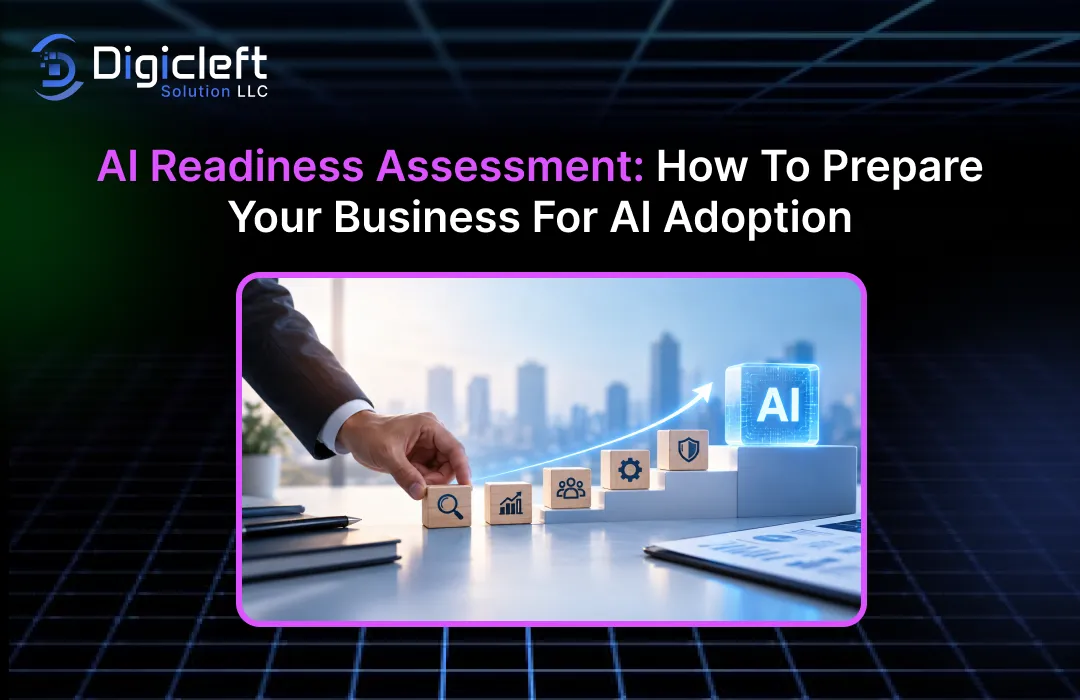
Artificial intelligence has moved far beyond being something businesses merely experiment with. Today, companies are exploring AI for customer support, marketing, sales, data analysis, software development, operations, finance, recruitment, and many other areas. However, there is a difference between having access to AI tools and being truly ready to use AI effectively. That difference is where an AI readiness assessment becomes important.
Before investing heavily in automation, AI agents, generative AI platforms, or custom AI solutions, a business needs to understand whether its strategy, data, technology, people, processes, and governance are prepared for the change.
This is especially important because AI adoption is accelerating. A 2025 IBM CEO study found that 61% of surveyed CEOs said their organizations were actively adopting AI agents and preparing to implement them at scale, while 68% considered integrated enterprise-wide data architecture important for cross-functional collaboration. At the same time, a 2026 IBM analysis reported that only 25% of workers surveyed were using AI regularly in their jobs, despite 86% of CEOs believing their people were ready.
This gap shows that AI adoption is not simply a technology project—it is a business transformation project.
What Is an AI Readiness Assessment?
An AI readiness assessment is a structured evaluation that helps a company understand how prepared it is to adopt, implement, and scale artificial intelligence.
Instead of immediately buying an AI platform and trying to find somewhere to use it, the assessment starts with the business itself. It examines questions such as whether your goals are clearly defined, whether your data is usable, whether your technology can support AI applications, whether employees have the right skills, whether processes are documented, and whether appropriate privacy and governance controls exist.
Think of it like preparing a building before installing sophisticated electrical equipment. You would not simply purchase the equipment and plug it into an unknown electrical system. You would first check the wiring, capacity, safety systems, infrastructure, and operating requirements. AI deserves the same kind of preparation.
Current assessment approaches commonly examine areas such as strategy, infrastructure, data, governance, talent, and culture. For example, Cisco’s AI Readiness Index evaluates organizations across these six pillars. PwC also describes its enterprise assessment as a way to measure AI maturity, identify capability gaps, and create a sequenced roadmap for adoption.
Why AI Readiness Matters Before Adoption
The biggest mistake a business can make is assuming that buying an AI tool automatically creates an AI capability. It does not.
A company may have an excellent AI model but poor data, unclear processes, limited employee adoption, weak security controls, or no reliable way to measure results. In that situation, the technology may look impressive during a demonstration but fail to create sustainable business value.
An AI readiness assessment helps uncover those weaknesses before they become expensive problems. It also prevents businesses from chasing every new AI trend.
Instead of asking, “What AI tool should we buy?”, leadership can ask a much more useful question: “Which business problem should we solve, and are we ready to solve it with AI?”
That shift in thinking can save time, reduce unnecessary spending, and make adoption considerably more practical.
Why Businesses Are Moving From AI Experiments to Adoption
AI experimentation has become common across industries, but businesses are increasingly looking beyond isolated experiments.
According to a 2025 IBM report, 61% of surveyed CEOs were actively adopting AI agents and preparing to implement them at scale. The same research found that 72% of surveyed CEOs considered proprietary company data important for unlocking generative AI value.
That matters because the next stage of AI adoption depends heavily on integration.
A chatbot sitting separately from a company’s CRM, website, support platform, inventory system, or internal knowledge base can only accomplish so much. The real opportunity often appears when AI becomes connected to the workflows employees already use.
For example, imagine an online retailer receiving hundreds of customer questions every day. A basic chatbot may answer frequently asked questions.
A more integrated AI system could potentially understand what customers need, find relevant product details, access approved knowledge sources, summarize conversations, create support tickets, and pass more complex cases to human representatives.
The difference isn’t simply about having better AI; it’s about better integration with business processes.
The Growing Importance of AI Strategy
A strong AI strategy should start with business goals rather than just focusing on technology.
If your company aims to decrease customer support response time, increase high-quality leads, improve forecasting, reduce repeated administrative tasks, or make internal knowledge more accessible, these objectives should shape your AI plan.
Indian business data also highlights why preparation is key. IBM’s 2025 India study showed that 87% of surveyed IT decision-makers in India said their organizations made major progress with their AI strategy in 2024, while 76% reported positive returns on AI investments. The study also found that governance is a major challenge as companies expand their AI use.
The lesson is clear: AI investment should have a good reason behind it.
A business doesn’t become AI-ready by buying many AI products. It becomes AI-ready when leadership knows where AI can bring value, understands what needs to change, and has a real system for managing that change.
The Six Core Areas of AI Readiness
An effective AI readiness assessment should look at the business from different angles rather than using only one score.
One company might be highly advanced in technology but have poor AI governance. Another might have good data but lack people who know how to use AI well. A useful assessment, therefore, gives a full picture.
1. Strategy and Business Goals
The first question is strategic: Why does your business want to adopt AI? The answer should directly connect to measurable business outcomes.
For example, saying “We want to use AI” is not helpful. Saying “We want to reduce average customer support handling time by 25% while maintaining customer satisfaction” is much more useful.
Similarly, “We want AI in marketing” is vague, while “We want to automate the first draft of product descriptions and reduce content production time” gives a clear starting point.
Your assessment should identify executive support, AI priorities, budgets, expected results, who makes decisions, and how success is measured.
It should also distinguish between short-term opportunities and long-term changes. Without this strategic layer, AI projects may become unconnected experiments led by individual departments.
2. Data and Technology Infrastructure
AI systems rely on technology and, more importantly, usable data.
Your organization should check where data is stored, who owns it, how accurate it is, how often it is updated, and whether different systems can share information.
Poor data leads to poor AI results. If customer records have duplicates, product information is outdated, documents are scattered across different systems, or key knowledge lives only in employees’ minds, AI can’t just fix these issues automatically.
Technology readiness should consider APIs, cloud infrastructure, cybersecurity, software integration, storage, computing needs, and system scalability.
The goal isn’t necessarily to build a huge AI setup before starting. Instead, you want to know whether your current setup can support the specific use case you are thinking about.
3. People, Skills, and AI Culture
Technology is just one part of AI adoption. Employees need to understand how AI fits into their work. They need proper training, clear policies, and confidence in when AI can and cannot be used.
This is especially important because there can be big adoption gaps. IBM’s 2026 report found that only 25% of workers surveyed used AI regularly at work, even though 86% of CEOs thought employees were ready.
That gap shouldn’t always be seen as resistance. Sometimes people just don’t know which tools are approved, what tasks AI can handle, how to create useful prompts, how to check AI-generated content, or where human review is necessary.
An AI readiness assessment should therefore look at both technical ability and the organization’s readiness.
How to Evaluate Your Business Processes
AI works best when applied to a well-understood process.
Before automating any task, document how the work is done today. Who does the task? What information do they need? What decisions do they make? Where are delays introduced? How often does the process happen? What is the cost of an error?
This exercise can highlight opportunities that are often missed.
A company may initially decide to implement an AI chatbot because its competitors have one, but a process analysis might show that a more significant opportunity lies in automating tasks like quotation preparation, invoice processing, internal reporting, or lead qualification.
Process documentation also helps uncover inconsistencies. If five employees carry out the same workflow in five different ways, it may not be the best time to introduce automation.
AI requires a sufficiently clear and well-defined process to function effectively. Most AI readiness assessment tools include factors such as process documentation, standardization, workload volume, and repeatability when evaluating suitability.
Finding the Right AI Use Cases
Not all business processes should be automated.
The best starting point is often a workflow that is repetitive, measurable, reasonably predictable, and valuable enough to justify improvements.
A helpful evaluation can consider the following:
- Business value: How much time, money, revenue, or customer value could be affected?
- Frequency: Does the task occur often enough to provide meaningful savings?
- Data availability: Is the necessary information accessible and reliable?
- Complexity: Can the task be handled within clearly defined boundaries?
- Risk: What happens if the AI makes an error?
- Human oversight: Can an employee review important decisions?
- Integration: Can the AI solution connect with existing systems?
This approach turns AI adoption into a prioritization process rather than simply shopping for technology.
Start With High-Value, Low-Risk Workflows
For many organizations, the first AI project should not involve the most sensitive or complex business decisions.
Starting with a controlled workflow allows teams to understand how AI behaves in their environment.
For example, an internal document-search assistant may be easier to manage than an AI system making high-impact decisions. A content-drafting workflow may be simpler to measure than a fully autonomous customer-service system. A sales-research assistant might be a practical starting point because a salesperson can review the output before using it.
The goal of an initial pilot is not to prove that AI can do everything. It is to learn what works, identify limitations, set up controls, measure value, and build confidence within the organization.
Data Readiness: The Foundation of Successful AI
Data is often the key to AI success or failure.
Businesses sometimes focus heavily on choosing the right model while neglecting whether the data input is accurate, current, structured, accessible, and properly managed.
An AI readiness assessment should therefore examine data ownership, quality, availability, storage, integration, permissions, retention, and security.
It is important to know which datasets contain sensitive information and who is authorized to access them.
According to IBM’s 2025 CEO research, 68% of surveyed CEOs considered an integrated enterprise-wide data architecture critical for cross-functional collaboration, while 72% identified proprietary data as important for unlocking generative AI value.
Data Quality, Accessibility, and Security
Imagine asking an employee to prepare an important business report while giving them five conflicting spreadsheets, three outdated documents, and no explanation of which version is correct. You would not expect a reliable outcome. AI faces a similar challenge.
Before implementing AI, organizations should identify authoritative sources and establish clear data ownership.
Sensitive information should have appropriate access controls. Data pipelines should be monitored, and critical outputs should be validated rather than accepted automatically.
For businesses adopting generative AI, this becomes especially important because employees may inadvertently expose confidential information through unauthorized tools.
Clear policies should explain which information can be entered into AI systems, which tools are approved, and how generated content must be reviewed.
AI Governance, Privacy, and Risk Management
AI governance is not about preventing employees from using AI. When implemented correctly, it provides a framework that allows organizations to use AI while managing risks.
The NIST AI Risk Management Framework is designed to help organizations incorporate trustworthiness considerations into the design, development, use, and evaluation of AI systems.
Its approach emphasizes understanding and addressing risks and potential impacts throughout the AI lifecycle.
Training and Change Management
Leadership must explain why AI is being introduced and what success means.
Employees need to understand which tasks remain their responsibility and where AI support is expected.
This is important because adopting new technology often involves changing behaviors.
Even a powerful AI system may not deliver much value if employees lack trust, struggle to use it, or do not understand how it fits into their work.
An AI readiness assessment should therefore check whether the organization has an AI learning plan, internal supporters, leadership backing, communication strategies, and ways to collect employee feedback.
How to Build an AI Adoption Roadmap
After completing the assessment, the next step is to turn the findings into a roadmap.
Avoid creating a document that simply lists vague ideas like “improve data,” “train employees,” and “adopt AI.” These statements are too general to guide real action.
Instead, convert any gaps into specific projects that include owners, deadlines, dependencies, costs, and measurable results.
From Assessment to Pilot Project
A realistic roadmap can start with three stages.
Stage One: Foundation
Clean up important data, document processes, define AI policies, select approved tools, and assign ownership.
Stage Two: Pilot
Choose one or two use cases with clear goals. Set a baseline before implementation to compare performance after the project starts.
Stage Three: Scale
If the pilot shows value and meets governance standards, integrate it into broader workflows and expand gradually.
The assessment should not be treated as a one-time check. AI technology evolves quickly, business goals shift, and new risks arise. Regularly reviewing readiness can help ensure the roadmap stays relevant.
Measuring ROI and Improving Over Time
AI investment should be measured based on business results, not just enthusiasm for the technology.
Depending on the use case, useful metrics may include time saved, cost per transaction, conversion rate, response time, error rate, employee adoption, customer satisfaction, revenue contribution, or operational efficiency.
For instance, if an AI assistant saves 15 minutes per employee each day, the actual business benefit should be calculated, not just stated as “saving time.”
If an AI sales assistant generates more leads, the quality and conversion of those leads should be measured rather than just the number of leads created.
This is where an AI readiness assessment becomes a powerful management tool rather than just a list of questions. It sets a baseline, identifies areas for improvement, and creates a path for tangible progress.
How AI-Ready Websites Support Business Growth
A company’s website is often the first place where AI readiness becomes noticeable to customers.
Modern websites can connect content, customer data, analytics, automation, search, personalization, and conversational features into a more integrated digital experience.
This makes the guide “How to Create: Engaging and Intuitive Websites for Maximum Impact” especially relevant.
An AI-ready website is not just about adding a chatbot to an existing page and calling it smart. The user experience should focus on clarity, accessibility, fast navigation, valuable content, organized information, and meaningful interactions.
For example, an AI-enabled website might help visitors find products, answer common questions, qualify leads, recommend relevant content, schedule appointments, or direct users to the right service.
However, these features only work well when the website’s structure and content are well-organized.
A strong digital foundation also makes future AI integration easier. Structured product data, clean analytics, accessible APIs, documented content, clear conversion paths, and well-defined customer journeys can all support future automation.
For businesses working with Digicleft Solution, this creates an opportunity to align website development with broader AI adoption planning.
Instead of treating the website as a separate marketing asset, businesses can see it as part of their overall digital infrastructure—one that supports customer engagement, data collection, automation, and future AI-driven experiences.
Conclusion
An AI readiness assessment provides businesses with something that technology hype often lacks: clarity.
Instead of rushing to adopt the latest AI tool, organizations can understand their current situation, identify gaps, prioritize valuable use cases, and develop a realistic roadmap.
The key takeaway is that AI readiness is not about company size or the number of AI subscriptions a business owns.
It depends on whether the organization has clear goals, reliable data, appropriate technology, capable people, well-documented processes, responsible governance, and a culture open to learning.
AI adoption is increasingly being integrated into various aspects of business operations. New findings from IBM indicate that top management is highly interested in expanding AI usage. However, data on current employee engagement shows that getting staff on board remains a major challenge.
Therefore, instead of asking “Which AI tool should we use?” consider asking a more important question: “Is our business ready to use AI effectively?”
A thorough evaluation can help determine the real state of readiness and guide the next steps.
FAQs
1. What is an AI readiness assessment?
An AI readiness assessment is a review of how prepared a company is to implement and grow the use of artificial intelligence.
It usually looks at elements such as strategy, data, technology, processes, employees, governance, security, and company culture.
2. Why should a business do an AI readiness assessment before adopting AI?
This assessment helps spot problems before a lot of money and time are spent.
It can uncover issues related to data quality, workflows, employee capabilities, systems, security, or control that could negatively affect the success of an AI project.
3. What should an AI readiness assessment cover?
A complete evaluation should consider aspects like business strategy, use cases, data quality, infrastructure, cybersecurity, governance, employee skills, process maturity, company culture, and how to measure return on investment.
Different frameworks and available assessments may group and score these factors differently.
4. Is an AI readiness assessment necessary for small businesses?
Yes.
Small businesses don’t need a complex enterprise-level evaluation, but they can still benefit from looking at their procedures, data, people, tools, risks, and goals before investing in AI.
A brief review can highlight practical applications such as customer service automation, content creation workflows, lead qualification, reporting, or internal knowledge sharing.
5. How can a business begin preparing for AI adoption?
Begin by identifying one specific business issue that can be measured.
Record the current process, check available data, evaluate risks, choose a relevant AI application, define human supervision, set performance targets, and run a controlled test.
Once the trial shows clear value, the organization can decide whether and how to expand its use.