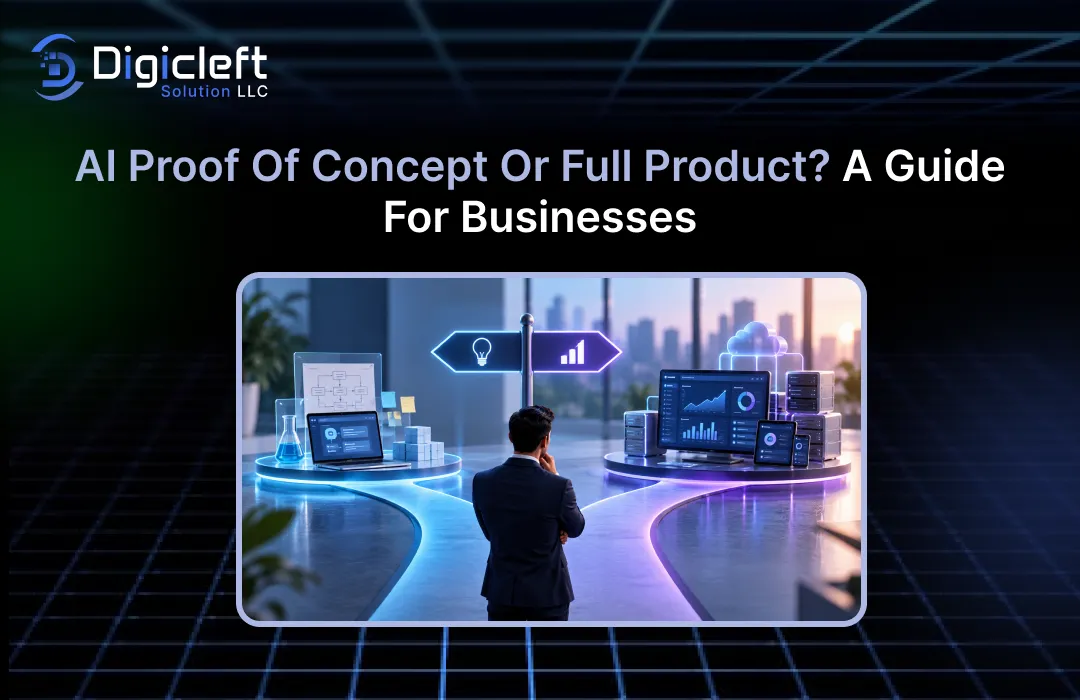
An AI Proof of Concept (PoC) is a focused experiment intended to address a specific question: Can this AI idea function effectively within our business setting?Rather than investing right away in a full application, a company creates a simplified version to evaluate aspects such as technical feasibility, data quality, model performance, workflow compatibility, or other key assumptions.Think of it as testing the engine before building the complete car.The goal is not to develop the finished product but to determine whether the engine can perform as expected.
This distinction is important because AI projects can appear promising during demonstrations but face significant challenges when applied in real business settings.
AWS highlights that a robust generative AI PoC is a method to confirm business value, data readiness, technical viability, and project risks before making larger investments.A PoC can help prevent a business from spending months on a solution that turns out to be unreliable, too costly, difficult to integrate, or unsuitable for the actual issue.
What a PoC Actually Proves
A well-designed AI PoC should have a clear hypothesis and specific success criteria that can be measured.
For example, a company might want to assess whether an AI system can accurately extract information from large volumes of documents.Another business might aim to determine if an AI assistant can effectively answer customer queries using its internal knowledge base.The PoC should focus on this uncertainty rather than attempt to include all features that might be part of the final product.
IBM suggests evaluating technical feasibility, selecting an appropriate use case, defining data needs, choosing models, identifying integration points, and setting performance metrics before developing a generative AI PoC.
This approach transforms the PoC from a flashy demonstration into a valuable tool for decision-making.By the end, the business should understand what worked, what did not, what remains uncertain, and what is needed to proceed further.
What Is a Full AI Product?
A complete AI product is designed for real users, real workflows, and real operational needs.
Unlike a PoC, it cannot depend on temporary solutions simply because the project is being tested internally.A production product requires proper architecture, security, monitoring, usability, reliability, data management, integration capabilities, support structures, and a strategy for continuous improvement.
Think of the difference between building a model house and operating a hotel.
The model house helps you visualize the design, but the hotel requires plumbing, electricity, fire safety, maintenance, guest services, and other operational elements.An AI product faces similar challenges.The model itself is just one component of the complete system.
How a Production Product Differs From a PoC
A PoC may use a limited dataset, manual processes, temporary interfaces, or a single model configuration.
A production system, on the other hand, must function consistently under normal operating conditions.It must also handle unexpected inputs, system failures, changing data, user permissions, system outages, and potential increases in demand.
For AI applications, production requirements become especially important when the system accesses business data or performs actions.
AWS points out that production-grade generative AI applications may need security, privacy measures, compliance, cost control, operational support, resilience, enterprise integration, data connectivity, and safeguards.
This is why companies should not treat a successful PoC as evidence that the full product is complete.
A successful PoC demonstrates a specific capability.A complete product proves that the business can operate the solution reliably.
AI PoC vs Full Product: The Key Difference
The easiest way to understand the difference is this:
A PoC asks, “Can we make this work?” A product asks, “Can we make this work reliably for real users and achieve sustainable business value?”
These are related questions, but they are not the same.
A PoC typically has a narrow scope and focuses on addressing uncertainty.A product has a broader scope and focuses on delivering consistent value.
| Factor | AI Proof of Concept | Full AI Product |
|---|---|---|
| Main purpose | Test feasibility | Deliver business value |
| Audience | Internal team or selected stakeholders | Real users/customers |
| Scope | Narrow | Broader |
| Design | Functional experiment | Production-ready experience |
| Security | Basic or limited | Comprehensive |
| Scalability | Usually not the priority | Important |
| Data | Limited test data may be used | Production data and governance |
| Success measure | Hypothesis validated | User adoption and business outcomes |
| Investment | Lower initial investment | Higher investment |
| Long-term support | Usually limited | Required |
Current product-development guidance also distinguishes a PoC from an MVP: a PoC primarily tests whether an idea is technically or practically possible, while an MVP is intended for real customers and tests whether they will use the product and find value in it.
Cost, Risk, Time, and Business Goals
The decision should not simply be based on which option is cheaper.
A PoC generally reduces early investment risk, but it introduces another stage into the development process.A full product requires more resources upfront, but it can make sense when the business already has strong evidence that the problem is important, the technology is understood, and customers are ready for the solution.
The real question is: What uncertainty is your business trying to remove?
If you are uncertain about the technology, start with a PoC.
If you already understand the technology and have validated the customer problem, moving toward an MVP or production product may be more appropriate.
When Should a Business Start With an AI PoC?
A business should seriously consider an AI PoC when there is a meaningful technical or operational question that has not yet been answered.
Maybe the company has valuable data but does not know whether an AI model can extract useful patterns from it.Perhaps an AI agent needs to interact with several internal systems, and the team is unsure whether the integrations can work securely and consistently.
A PoC is also useful when the project involves unfamiliar technology.
Generative AI, computer vision, predictive analytics, natural language processing, and AI agents can behave differently depending on data, context, infrastructure, and workflow design.Testing these factors early can expose problems before they become expensive architectural decisions.
A PoC can be particularly useful when:
- The technical feasibility is uncertain.
- The required data has not been tested.
- AI accuracy is difficult to predict.
- Integration with existing software is complicated.
- The project involves significant regulatory or security considerations.
- Leadership needs evidence before approving a larger investment.
- The business wants to compare multiple technical approaches.
The goal should be learning, not presentation.
A PoC that looks beautiful but fails to answer the important business question is not particularly useful.
When Does a Full AI Product Make More Sense?
Sometimes the business already knows enough to justify building a usable product.
If customers are actively asking for the solution, the workflow is well understood, the technology has already been validated, and the company has the resources to operate the system, continuing to experiment indefinitely can become counterproductive.
This is where a carefully scoped MVP or production product becomes valuable.
AWS describes an MVP as a basic version that demonstrates the core benefit while allowing a business to gather feedback from early users.
For example, imagine an e-commerce company has already tested an AI product-recommendation engine and confirmed that the required data is available.
Instead of building another internal demo, the company might release a limited customer-facing version.That product can measure actual usage, collect feedback, and reveal whether customers interact with the recommendations.
The important point is that production should not mean building everything at once.
A business can still start small while building something real.
The Business Questions to Answer Before Building
Before spending heavily on either a PoC or full product, step back from the technology.
What problem are you actually trying to solve?Who experiences that problem?How frequently does it occur?What does the current process cost?What would change if AI solved part of it?
These questions may sound obvious, but they can prevent a surprising amount of wasted development work.
A technically impressive AI system has little business value if it solves a problem nobody cares about.
The business case must take into account several important factors such as expected revenue, cost savings from operations, improvements in customer experience, increased employee productivity, initial implementation costs, associated risks, and the time it will take to see value.
IBM similarly suggests that when deciding which AI use cases to prioritize, it is important to evaluate the potential business impact in addition to the complexity, resources needed, and the time required for implementation.
Technical Feasibility and Data Readiness
Data is especially important because the effectiveness of AI is closely linked to the quality, availability, and context of the data provided.
Consider where the data is stored, who is responsible for it, how up-to-date it is, whether it contains sensitive information, and whether it is both legally and technically acceptable for the intended use.
Next, examine the AI workflow.
Which model will be used?Does the system require retrieval-augmented generation?Is there a need for an AI agent capable of performing actions?What happens when the model is unsure or uncertain?
These questions become even more crucial when moving from experimenting with AI to deploying it in a real-world setting.
Recent IBM commentary on scaling AI highlights that organizations must have high-quality, compatible, and easily accessible data, along with governance and security measures, in order to move beyond isolated AI applications.
How to Build an Effective AI Proof of Concept
Start with one significant issue rather than trying to tackle many at once.
Clearly define what the proof of concept (PoC) needs to demonstrate and select a small but representative dataset.Establish measurable criteria before beginning the development process.
For instance, if a company wants an AI system to categorize incoming support tickets, instead of simply asking if the AI is “good,” define specific and measurable goals such as classification accuracy, processing time, escalation rate, and the cost per ticket.
This gives the team a clear standard to evaluate against.
The PoC should also be tested under realistic conditions whenever possible.
If the final product will use messy business documents, testing with only perfectly formatted sample files may give an overly optimistic view.If the AI needs to retrieve information from internal systems, it is better to test the real integration challenges instead of just using a mockup.
A strong PoC should conclude with a clear decision: whether to scale the solution, modify it, repeat the process, or stop.
That final choice is one of the most valuable outcomes of the entire exercise.
How to Move From PoC to a Production AI Product
A successful PoC is not the end goal.
It serves as evidence that the next stage is worth exploring.
The transition from a PoC to a production-ready AI product should begin by reviewing what was learned.
Which components can be reused?Which parts were temporary?What assumptions were validated?What challenges were discovered?What changes would be necessary before real users can rely on the system?
An example of this comes from IBM’s case study of Wintershall Dea, where the organization used smaller AI projects and developed strategies for taking proofs of concept into production and scaling them up.
The transition should be treated as both an engineering and a business process, rather than simply adding more features.
Security, Scalability, and User Experience
Production AI requires a different approach.
Authentication, authorization, monitoring, logging, privacy, data governance, model evaluation, error handling, cost controls, and human oversight become essential considerations.
User experience is equally important.
An AI system may be technically impressive but still fail if users do not understand its function.If the interface is confusing, people may avoid the product, regardless of how capable the underlying model is.
This is where website and product design play a crucial role.
If your AI product is for customers, investing in clear navigation, intuitive workflows, responsive design, accessible interfaces, and clear AI interactions can make the difference between an interesting demonstration and a product that people actually use.
Businesses looking to enhance the broader digital experience may also want to consider How to Create: Engaging and Intuitive Websites for Maximum Impact when planning the user-facing side of an AI product.
A practical digicleft solution can help connect the technical AI layer with a website experience that feels simple and not overwhelming.
Common Mistakes Businesses Make With AI Projects
One frequent error is developing the full product before confirming the most critical assumption.
Another mistake is creating a proof of concept (PoC) without clearly defining what success looks like.Both practices can lead to challenges due to different reasons.
Businesses sometimes get sidetracked by choosing the right AI model.
Teams might spend excessive time deciding which model is best before fully understanding the workflow, data, user needs, and expected outcomes.While selecting the right model is important, it is just one part of the overall system.
There is also confusion between a successful demo and a product ready for production.
A demo might function flawlessly when provided with carefully chosen inputs.However, a real-world application must handle unpredictable user behavior, inconsistent data, security needs, changing information, system failures, and varying user expectations.
Another issue is feature overload.
A PoC might begin with a single goal, but it can quickly expand to include authentication, dashboards, mobile apps, multiple integrations, analytics, and many other features.What was once a simple experiment can evolve into a major software project.
Stay focused on the experiment.
How Website Experience Supports AI Product Adoption
AI products are not developed in isolation.
Customers interact with them through various interfaces, such as websites, dashboards, mobile apps, chat windows, portals, and internal tools.This means the interface must clearly explain what the AI does, what users can expect, and when human support is needed.
Good user experience (UX) can make complex technology seem user-friendly.
Users should not need to understand large language models, retrieval systems, APIs, or AI agents to complete a task.
For businesses creating an AI product, it is essential to consider the entire user journey.
Where do users first encounter the solution?How quickly can they grasp its value?What information do they need before trusting the AI?What happens if the AI makes a mistake?Can the user easily correct or override an AI-generated result?
These considerations are part of product planning, not just design.
A well-designed AI experience bridges the gap between technical capabilities and human behavior.
AI PoC or Full Product: A Practical Decision Framework
There is no one-size-fits-all solution.
The best approach depends on factors like the level of uncertainty, business maturity, available resources, customer validation, technical complexity, and the consequences of failure.
Use a PoC-first approach when the main unknown is whether the technology can work.
Choose an MVP or product-first approach when the technology is well understood, and the bigger question is whether users will adopt and appreciate the solution.
A simple framework can help:
| Your Current Situation | Sensible Starting Point |
|---|---|
| Technology is unproven | AI PoC |
| Data quality is uncertain | AI PoC |
| Integration risk is high | AI PoC |
| Customer problem is unclear | Prototype/MVP research |
| Customer demand is validated | MVP |
| Technology is already proven | MVP/full product |
| Existing product needs AI enhancement | Targeted production feature |
| High-risk AI workflow | PoC followed by controlled production rollout |
The best path may also involve a staged approach like PoC → MVP → production.
The PoC addresses technical uncertainty.The MVP tests real-world assumptions.Production engineering then transforms the validated idea into a dependable business function.
This staged method also allows leadership to have clearer investment milestones.
Instead of requesting a large budget based on assumptions, the team can provide evidence at each stage.
Conclusion
Deciding between an AI Proof of Concept and a full product is really about what your business needs to learn before making the next investment.
If technical feasibility, data readiness, model performance, or integration remains unclear, a focused PoC can offer valuable insights without committing to a large-scale build.If these questions are already well understood and demand is validated, moving toward an MVP or production-ready product can generate more meaningful insights.
The key is not to treat a PoC as a scaled-down version of the final product.
Its purpose is to answer a specific question.Likewise, a full product should not be viewed as an oversized experiment; it must deliver reliable value to real users.
AI development works best when businesses combine experimentation with discipline.
Start with the actual business problem, identify the main uncertainty, measure what matters, and invest progressively as evidence improves.This way, your AI strategy becomes less about chasing technology and more about building something that truly adds value to the business.
FAQs
1. What is an AI Proof of Concept?
An AI Proof of Concept is a limited technical or business experiment aimed at assessing the feasibility of a particular AI solution.
It typically focuses on one or more areas of uncertainty, such as data quality, model performance, integration, accuracy, or workflow viability, rather than creating a full customer-facing product.
2. Is an AI PoC cheaper than building a full product?
Generally, a narrowly focused PoC requires less initial investment since it addresses a specific question without needing all the features of a production-ready product.
However, the cost can vary based on factors like the technology used, data requirements, integration needs, security measures, and the complexity of the experiment.The main financial advantage of a PoC is that it helps lower the risk of making a large investment in an approach that may not work.
3. How long should an AI PoC take?
There is no standard timeframe for a PoC.
It should be long enough to provide credible evidence that answers the specific question it was designed to address.The scope should be narrow enough that the team can effectively measure the outcome without turning the PoC into an unofficial full product.
4. Should every AI project start with a PoC?
Not necessarily.
If the technology has already been validated, the business problem is clearly understood, and there is evidence of user demand, it may be more efficient to move directly toward an MVP or production implementation.A PoC is most beneficial when there are significant uncertainties that could influence the investment decision.
5. What comes after a successful AI PoC?
A successful PoC should lead to a documented decision and a clear roadmap.
Depending on the results, the next step might involve refining the concept, building an MVP, conducting further testing, or transitioning into controlled production.The transition should address important aspects like security, scalability, data governance, monitoring, user experience, integrations, and operational support, rather than simply replicating the PoC in production.