
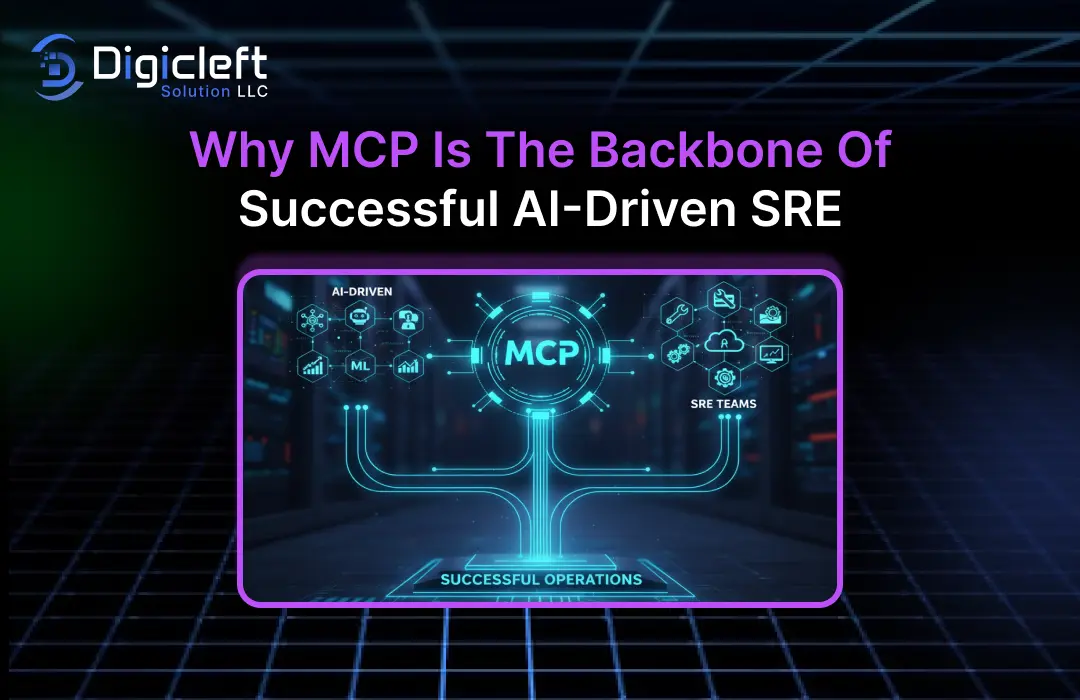
If Site Reliability Engineering (SRE) were a living being, the Machine Control Plane (MCP) would be its backbone strong and adaptable. In today’s AI-driven world, where systems must think, predict, and respond in milliseconds, MCP ensures that reliability isn’t accidental it’s engineered.
Let’s explore how this hidden layer, combined with innovations like Digicleft Solution, powers the future of reliability automation.
Understanding the Core Concepts
What is SRE?
SRE (Site Reliability Engineering) is about ensuring systems run smoothly and efficiently. It blends software engineering with operations turning chaos into consistency.
What is AI-Driven SRE?
AI-driven SRE introduces intelligence into the mix machine learning models predict failures, automate recovery, and learn from incidents to make systems more resilient over time.
What Exactly is MCP?
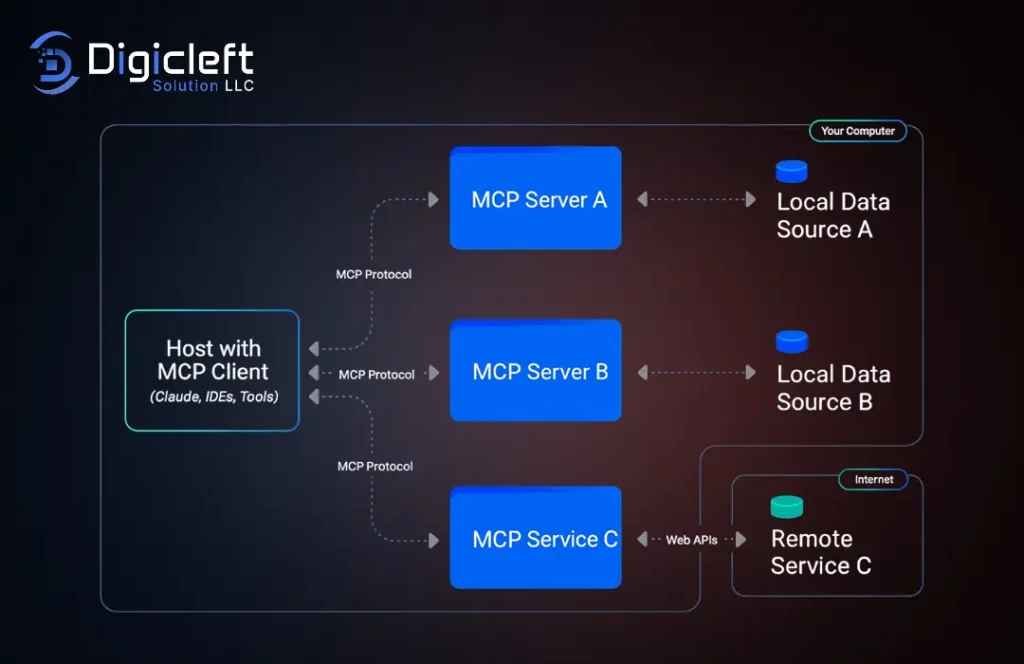
The Machine Control Plane (MCP) acts as the command center that coordinates AI models, automation tools, and monitoring systems. It’s the layer where decision-making logic resides ensuring the right action happens at the right time.
How AI and SRE Intersect
In traditional SRE, humans were the drivers detecting anomalies, managing alerts, and executing fixes. But as architectures became distributed, human-only oversight became impractical.
Enter AI-driven SRE, where algorithms augment human expertise. Yet, without a centralized control layer, these AI components can’t communicate effectively. That’s where MCP steps in the translator, conductor, and enabler of dependable operations.
The Role of MCP in AI-Driven SRE
Think of MCP as a digital captain orchestrating a symphony of systems. It ensures harmony between AI-driven insights and operational actions. When an anomaly occurs, MCP doesn’t just respond it decides the best course, whether it’s triggering a rollback, scaling resources, or alerting an engineer.
It’s not just automation it’s intelligent coordination.
Key Components of MCP
- Control Logic: Defines how systems should respond under various scenarios from traffic surges to service degradations.
- Policy Enforcement: Ensures every action complies with predefined rules and security standards, keeping chaos in check.
- Feedback Loops: Enables learning from past incidents making AI smarter with every event handled.
- Observability and Learning: Analyzes system telemetry and feeds data back into AI models, creating a self-improving reliability cycle.
Why MCP Matters
From Reactive to Predictive
Traditional SRE is reactive fix it when it breaks. MCP makes it predictive prevent it before it breaks.
Unifying Fractured Tools
Instead of juggling dashboards, MCP integrates everything into one intelligent control system.
Enhanced Decision-Making
By combining AI insights with historical data, MCP provides data-driven decisions in real time no guesswork, just clarity.
Digicleft Solution – A Modern MCP Enabler
When we talk about digital transformation, Digicleft Solution stands out as a reliable enabler of modern MCP frameworks. It provides scalable, AI-driven infrastructure management turning static systems into self-regulating ecosystems.
With Digicleft Solution, organizations can:
- Integrate AI-based monitoring seamlessly
- Automate incident triage and root cause analysis
- Ensure continuous reliability without constant human oversight
It’s not just technology it’s the next evolution of digital reliability.
The Backbone Analogy – MCP as the Central Nervous System
Your nervous system sends signals, processes responses, and keeps you alive that’s MCP for your infrastructure. It connects every sensory input (logs, metrics, traces) with the brain (AI models) and the muscles (automation tools). Together, they create reflex-like responses faster, smarter, and often invisible to end users.
Benefits of MCP in AI-Driven SRE
- Improved Uptime: Issues are resolved before customers even notice.
- Reduced Human Error: AI handles repetitive, error-prone tasks.
- Faster Incident Response: Real-time decision-making shortens downtimes.
- Continuous Learning: Every incident adds new intelligence to the system.
- Operational Efficiency: Teams focus on innovation instead of firefighting.
MCP and Predictive Reliability
By analyzing telemetry data, MCP allows AI models to predict potential issues from hardware failures to network congestion. Imagine knowing a system will degrade two hours before it actually does that’s predictive reliability in action.
Real-World Example – AI Incident Management
Let’s say a web application experiences slow response times. The MCP detects abnormal latency, triggers an AI model to diagnose possible causes, and executes a remediation scaling servers or rolling back a deployment all before customers raise a ticket.
That’s the power of autonomous reliability quietly saving millions in downtime costs.
Challenges in Implementing MCP
- Complex Integration: Connecting legacy systems with AI-driven frameworks can be tricky.
- Data Silos: MCP requires unified visibility across environments.
- Security Concerns: Automated decision-making must be tightly governed.
- Cultural Shift: Teams must trust AI decisions, not fear them.
Future of MCP in AI SRE
Tomorrow’s MCP won’t just manage it will self-heal. We’re heading toward architectures that fix, optimize, and scale themselves based on real-time conditions.
Edge computing, IoT, and generative AI will expand MCP’s reach making reliability a living, adaptive process.
How Organizations Can Adopt MCP
- Assess Readiness: Evaluate current monitoring and automation maturity.
- Define Policies: Establish what MCP can and cannot do autonomously.
- Integrate AI Models: Use predictive algorithms for incident detection.
- Pilot Small: Start with limited automation before scaling.
- Partner with Experts: Platforms like Digicleft Solution simplify the transition with ready-to-integrate AI SRE modules.
Conclusion
MCP isn’t just another tool in the AI-driven SRE toolbox it’s the toolbox. It’s the central nervous system that gives modern infrastructure awareness, adaptability, and foresight.
With solutions like Digicleft, enterprises can move beyond uptime metrics to build systems that are truly self-reliant and intelligent.
In the era of AI-driven reliability, MCP is and will remain the invisible hero behind every seamless digital experience.
FAQs
1. What does MCP stand for in SRE? MCP stands for Machine Control Plane the central layer that coordinates AI and automation in reliability engineering.
2. How does MCP improve AI-driven SRE? It unifies monitoring, decision-making, and automation, allowing systems to detect, predict, and resolve issues autonomously.
3. Can small organizations use MCP? Absolutely! Tools like Digicleft Solution make MCP adoption scalable for startups and enterprises alike.
4. What are the main challenges in MCP deployment? Integration complexity, data consistency, and security governance are common challenges.
5. Is MCP the future of SRE? Yes it’s the foundation for self-healing, AI-powered systems that define the future of digital reliability.