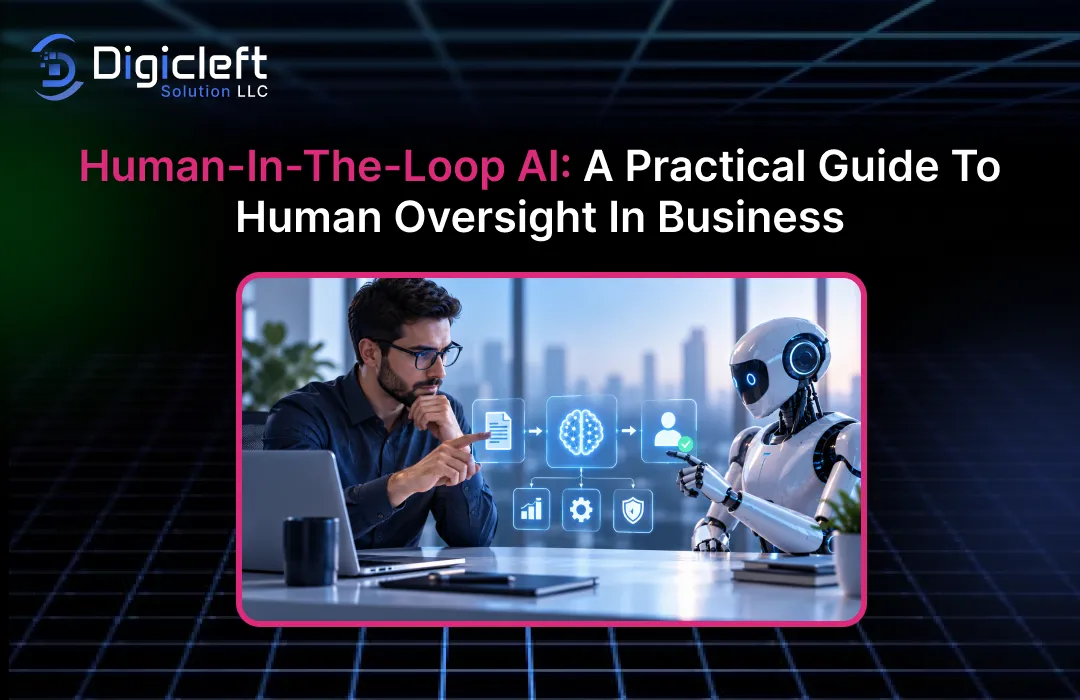
Artificial intelligence is becoming a standard part of how businesses operate. It can respond to customer inquiries, analyze documents, recommend actions, detect irregular activities, create content, and even support employees in decision-making. However, there is one issue that businesses must not overlook: where should human involvement remain?
This is where Human-in-the-Loop AI (HITL AI) plays a key role. Rather than letting AI function entirely on its own, HITL AI intentionally includes people at crucial stages in the process. A human might approve an AI suggestion, check a high-risk decision, correct an output, or step in when the system is uncertain.
This approach does not suggest that businesses should avoid automation. In fact, it supports the use of automation where it is effective, while ensuring human judgment is available when context, responsibility, empathy, or professional knowledge is essential.
The NIST AI Risk Management Framework acknowledges that human-AI systems can range from completely manual to fully automated and that some AI applications specifically need human supervision.
What Is Human-in-the-Loop AI?
Human-in-the-Loop AI is a workflow in which a human is actively involved in checking, approving, correcting, or guiding the output of an AI system before a key action is taken. Think of the AI as a very efficient assistant rather than a final decision-maker.
For instance, an AI system might evaluate a loan application and spot potential risks. Instead of automatically rejecting the applicant, the system forwards the recommendation to a trained employee. That employee reviews the relevant details, considers factors the model might have missed, and makes the final call.
The same idea can apply to customer service. AI can sort incoming support requests, prepare responses, and identify urgent complaints. A human agent then checks sensitive cases before the response is sent to the customer.
The important thing is that human involvement should be meaningful. A person who just clicks “approve” on every AI suggestion without checking it is not providing proper oversight.
How Human Oversight Works
A typical HITL workflow usually follows these steps:
- AI receives and processes information.
- AI generates a recommendation, prediction, or draft.
- The system determines whether a human review is needed.
- A trained employee reviews the output.
- The employee approves, makes changes, rejects, or escalates the decision.
- The final action is recorded for accountability and to help improve future performance.
This creates a balanced system where the speed of machines and the judgment of humans work together effectively.
Why Businesses Need Human Oversight
AI systems can process vast amounts of information quickly, but speed does not always mean accuracy. Models can misinterpret context, provide incorrect information, reflect harmful patterns from their training data, or behave differently in new situations.
Human oversight provides organizations with a way to detect these issues before they lead to expensive mistakes.
The NIST AI Risk Management Framework highlights the importance of defining and documenting human oversight processes and clearly outlining the roles and responsibilities of humans in AI-supported decision-making.
This is especially crucial when AI is used for decisions affecting customers, employees, finances, security, compliance, or other areas where errors can have serious consequences.
Balancing Automation With Human Judgment
The goal is not to have a person behind every AI action. That would reduce the benefits of automation.
Instead, businesses can evaluate decisions based on risk. Low-risk and repetitive tasks may be automated, while higher-risk decisions may involve human review.
For example, an AI system could automatically handle routine customer questions but send refund disputes, legal complaints, or unusual account activity to a human.
This is a more realistic approach: automate routine work, handle meaningful uncertainties, and keep humans in charge of important decisions.
Human-in-the-Loop vs. Human-on-the-Loop
The terms may seem similar but have an important distinction.
In human-in-the-loop ai, a person is directly part of the decision-making process. The AI may propose a course of action, but the human checks or approves it before it is executed.
In human-on-the-loop ai, the AI can act more independently while a human monitors and steps in if necessary.
Comparison of Human-AI Oversight Approaches
| Approach | Human Role | Typical Use |
|---|---|---|
| Human-in-the-loop ai | Reviews or approves decisions | High-impact decisions |
| Human-on-the-loop ai | Monitors and intervenes | Larger-scale automation |
| Human-in-command | Maintains overall authority | Strategic governance |
Choosing the right configuration depends on the AI system, the business process, the potential for harm, and the acceptable level of risk.
Where Human-in-the-Loop AI Is Used
Human supervision can be incorporated into almost any business process where AI is involved in making decisions or generating outcomes.
Customer Service and Sales
AI can assist by summarizing conversations, suggesting replies, identifying customer emotions, and directing support tickets. Human agents can manage exceptional cases and handle sensitive interactions.
This combination is beneficial: AI handles routine tasks, allowing employees to focus on solving complex issues and building stronger customer relationships.
Finance, HR, and Operations
In finance, AI can help detect unusual transactions or summarize financial documents. In HR, it can organize job applications or support administrative tasks. In operations, AI can forecast demand, spot irregularities, or suggest resource allocations.
However, in these areas, organizations must be especially cautious when making decisions that impact individuals. Human review adds an extra layer of context and ensures accountability.
Key Benefits of Human-in-the-Loop AI
One major advantage of using Human-in-the-Loop ai (HITL) AI is maintaining control over risks without giving up on automation.
Businesses can benefit from AI’s efficiency while still relying on human judgment in situations where full automation might not be suitable. Human input also helps find repeated mistakes in AI models and improve systems over time.
Other benefits include:
- Better quality control
- Greater accountability
- More transparent decision-making
- Faster handling of unusual cases
- Improved customer experiences
- Reduced operational risks
- Ongoing feedback that helps improve AI
The National Institute of Standards and Technology (NIST) views human-AI interaction as essential for AI risk management and highlights that well-organized human-AI teams can combine strengths effectively.
Accuracy, Trust, and Risk Reduction
Trust is often overlooked when discussing AI adoption. Customers and employees may feel more comfortable with AI if they know that humans remain responsible for key decisions.
Human oversight can also create a feedback loop ai. If employees regularly correct the same type of AI output, it signals that the system needs attention—such as better data, clearer instructions, improved prompts, a different model, or a redesigned process.
How to Build a Human-in-the-Loop AI Workflow
Start by focusing on the business process rather than the AI tool itself.
Identify what the system needs to achieve, what decisions it will support, and what potential issues might arise. Then figure out where human involvement adds the most value.
Define Decision Boundaries
Not every AI output needs human approval.
A helpful approach is to classify actions based on risk levels: low, medium, or high. Low-risk actions may proceed automatically. Medium-risk actions might need sampling or monitoring. High-risk actions should require explicit human approval.
This makes human oversight more scalable and avoids making it a bottleneck.
Set Escalation Rules
Your AI system should know when to pause and seek human input.
Escalation can occur due to low confidence, unusual input, conflicting information, sensitive topics, policy limits, or high financial or operational impacts.
A strong workflow doesn’t just ask, “Can AI make this decision?” It also asks, “When should AI not make this decision?”
Challenges Businesses Should Expect
Human-in-the-loop AI isn’t perfect by default. Poorly designed oversight can lead to automation bias, where employees blindly trust AI recommendations.
There’s also the opposite issue: if humans must review too many insignificant AI outputs, they may become overburdened and start approving recommendations without proper checks.
Training is important too. Employees must understand how AI works, what it cannot do, and when they need to intervene.
The goal should be thoughtful oversight—not just having humans act as decorative approval buttons.
Human Oversight and AI Governance
AI governance provides the framework for human-in-the-loop ai workflows.
Organizations should document roles, set escalation procedures, monitor system performance, keep necessary records, and regularly check if the human oversight process is working effectively.
NIST’s AI Risk Management Framework specifically includes documented responsibilities for human-AI configurations and processes for human oversight.
Regulations are also increasing the importance of human oversight. Under the EU AI Act, deployers of high-risk AI systems must assign oversight to appropriately trained individuals. High-risk systems are subject to requirements related to risk management, documentation, traceability, transparency, accuracy, cybersecurity, and human oversight.
As of August 2, 2026, certain transparency obligations under the EU AI Act also apply to AI providers and users, including rules regarding interactions with AI and content generated or manipulated by AI.
Human Oversight and the Customer Experience
Human oversight should not stop at the back-end AI workflow.
The way customers interact with AI plays an important role in how they perceive and use it. A website that uses AI should ensure the experience is clear and easy to understand, rather than confusing. Visitors should be aware that they are interacting with an AI system, understand what kind of support it can offer, and know how they can get help from a person if needed.
Good website design helps make the transition from AI to human support feel natural. Having clear navigation, easy-to-read content, accessible interfaces, helpful calls to action, and obvious ways to escalate to a live person can turn AI from a confusing tool into a useful customer experience.
For businesses using AI, website design and AI workflow design should complement each other. While the technology may be advanced, the user experience must remain simple and intuitive.
The Role of Digicleft Solution
For businesses interested in AI-driven digital experiences, Digicleft Solution can help bridge the gap between technology, website experience, and business goals.
An effective AI-enabled website isn’t just about adding a chatbot to the homepage. It should cover the entire customer journey, from the first interaction to information gathering, lead generation, support, and seamless handover to human assistance.
The same applies to Human-in-the-Loop AI: the technology should support people without making the experience unnecessarily complicated.
When AI, website design, content, and human support are all planned together, businesses can create digital experiences that are faster and more personal, while still being trustworthy.
Conclusion
Human-in-the-Loop AI isn’t about slowing down artificial intelligence. Instead, it is about identifying where human judgment is most needed.
Businesses can automate repetitive tasks, analyze large amounts of data, and speed up daily operations, while ensuring that people remain involved during decisions that are sensitive, uncertain, or high-impact.
The best approach is not complete manual control or full automation. It is a well-thought-out partnership between people and machines, where each handles tasks they are best suited to do.
As AI becomes more integrated into business processes, organizations that clearly define decision boundaries, escalation rules, responsibilities, and oversight will be better prepared to use this technology responsibly.
The real question is not how much automation we can achieve. A better question is where human judgment creates the most value.
FAQs
1. What is Human-in-the-Loop AI?
Human-in-the-Loop AI is a method where people actively review, approve, correct, or guide AI outputs at specific stages of a business workflow.
2. Is Human-in-the-Loop AI better than full automation?
They serve different purposes. Simple, low-risk tasks may be handled by automation, while decisions involving greater uncertainty or impact can benefit from human oversight.
3. What businesses can use Human-in-the-Loop AI?
Almost any organization can use it, including those in customer service, finance, healthcare, HR, retail, technology, marketing, and operations. The level of human involvement depends on the situation and risk involved.
4. How can businesses prevent employees from blindly trusting AI?
Organizations can offer AI literacy training, set up review processes, monitor human decisions, establish escalation rules, and regularly evaluate AI performance.
5. Does Human-in-the-Loop AI reduce business efficiency?
Not necessarily. When implemented correctly, it allows AI to handle routine, high-volume tasks while directing human resources toward exceptions, complex cases, and decisions requiring judgment.