Artificial intelligence has advanced far beyond basic chatbots.
Now, AI systems can perform a wide range of tasks, such as summarizing private documents, searching company databases, analyzing emails, writing code, calling APIs, updating records, and even taking actions on behalf of users.This makes AI very powerful and useful, but it also brings a new kind of security threat that traditional software developers must be aware of: prompt injection attacks.Instead of exploiting a software bug with carefully written code, an attacker can sometimes manipulate an AI system by providing carefully worded instructions.Prompt injection is defined by NIST as an attack that takes advantage of untrusted input combined with a prompt given by a more trusted party.OWASP classifies this as LLM01:2025, its top risk for large language model applications.
The challenge in detecting these attacks is that the malicious input may appear completely normal.
It could be hidden in a webpage, email, PDF, code comment, product review, or other document that an AI system is processing.This means that securing an AI application is not just about creating a better system prompt and hoping the model follows it.A more secure approach is to treat the AI model as part of a larger security framework.This involves using permission controls and validation, separating trusted instructions from untrusted data, and requiring human approval before performing sensitive actions.OWASP suggests several defensive techniques, including limiting access to only what is necessary, isolating external content, validating outputs, testing for adversarial inputs, and requiring human confirmation for high-risk activities.
What Is a Prompt Injection Attack?
A prompt injection attack occurs when someone provides content that changes how an AI model behaves, which is different from what the application was designed to do.
Consider an AI assistant that is supposed to summarize customer emails.You give it a system instruction like, “Summarize incoming emails in three clear paragraphs.” However, a malicious email might include a different instruction that tells the model to ignore its original task, reveal confidential information, or perform some unrelated action.If the application treats the email’s content as a trustworthy instruction, the model might follow the malicious content instead of just summarizing the information.The core issue is that large language models process both natural-language instructions and data in the same context, making it difficult to clearly separate “what the AI should do” from “what the AI should read.”
This is why prompt injection is different from asking an AI an unusual question.
An unusual question does not necessarily mean an attack.The real security risk appears when the input is designed to change the application’s intended behavior, bypass security measures, expose sensitive information, or manipulate connected tools.The consequences of such an attack depend largely on what the AI has access to.A simple public chatbot might give an inappropriate or incorrect response, while an AI connected to internal databases, email accounts, payment systems, or administrative APIs could cause a much more serious security breach.OWASP points out that prompt injection can lead to the exposure of sensitive information, unauthorized access to functions, the execution of arbitrary commands through connected systems, and the manipulation of critical decisions.
Why Natural Language Creates a Security Challenge
Traditional applications usually separate commands from data.
For example, a database query can be parameterized so that user input is treated as data instead of as instructions that can be executed.However, with an LLM, the model is designed to understand natural language, which can at the same time describe data and provide instructions.This creates a more complex security boundary that is harder to control using only prompts.An attacker does not need to find a hidden software endpoint or exploit a memory bug; they can instead craft content that tricks the model into reinterpreting the situation.NIST specifically emphasizes this interaction between untrusted input and trusted prompts.
Direct vs Indirect Prompt Injection
There are two main types of prompt injection attacks that developers should understand: direct prompt injection and indirect prompt injection.
Direct injection happens when an attacker actively interacts with the AI system and intentionally submits harmful instructions.Indirect injection is more subtle because the attacker inserts instructions into another source, such as a website, document, email, repository, or other external file, that the AI later processes.
OWASP recognizes both types of vulnerabilities as critical forms of prompt injection, and Microsoft similarly differentiates between direct attacks and indirect attacks involving external information.
The distinction is important because indirect attacks can occur even when the legitimate user has no intention of harming the system.
For example, an employee might ask an AI assistant, “Read this webpage and summarize the important points.” The webpage might contain hidden or visible instructions meant to influence the assistant.The employee’s request appears harmless, but during processing, the AI encounters content that the attacker has controlled.This changes the security model significantly: developers must not only protect the user input field but also every external source that can be integrated into the model’s context.
Direct Prompt Injection
A direct attack usually starts with an attacker intentionally trying to override the AI’s instructions.
They might aim to get the model to ignore its existing guidelines, reveal system information, change its assigned role, or produce content that goes beyond its intended scope.OWASP describes direct prompt injection as either malicious or unintentional input that directly alters how the model behaves.
Developers should not assume that a single instruction, such as “Never reveal confidential information,” is a complete security measure.
A system prompt can affect the model’s behavior, but it should not be used in place of authorization, access control, input validation, or backend security.OWASP also warns that sensitive credentials and connection strings should never be included in system prompts, as prompts should not be considered a secure storage method.
Indirect Prompt Injection
Indirect prompt injection is especially significant for modern AI applications because today’s systems often pull information from external sources.
AI assistants might read emails, search websites, analyze uploaded files, review Git repositories, retrieve knowledge base articles, or process third-party documents.If any of these sources contain instructions controlled by an attacker, those instructions can be introduced into the model’s context.Microsoft considers this a major challenge since AI systems may not reliably distinguish between external content and legitimate instructions.
This is also why RAG does not automatically address prompt injection.
Retrieval-augmented generation can improve an application’s access to relevant information, but the retrieved information can itself be malicious.OWASP clearly states that RAG and fine-tuning do not completely eliminate prompt injection vulnerabilities.
How Prompt Injection Attacks Work
In general, a prompt injection attack involves creating a conflict between the application’s intended instructions and the attacker’s controlled content.
The attacker aims for the model to prioritize the malicious instruction over the developer’s intended guidance.In a simple chatbot, this might result in an unexpected response.In an agentic system, the model might also have access to tools, which changes the potential impact because the model’s output can act as input to another system.Microsoft notes that indirect prompt injection can be used to carry out unauthorized actions, data breaches, and loss of system integrity.
A Typical Attack Flow
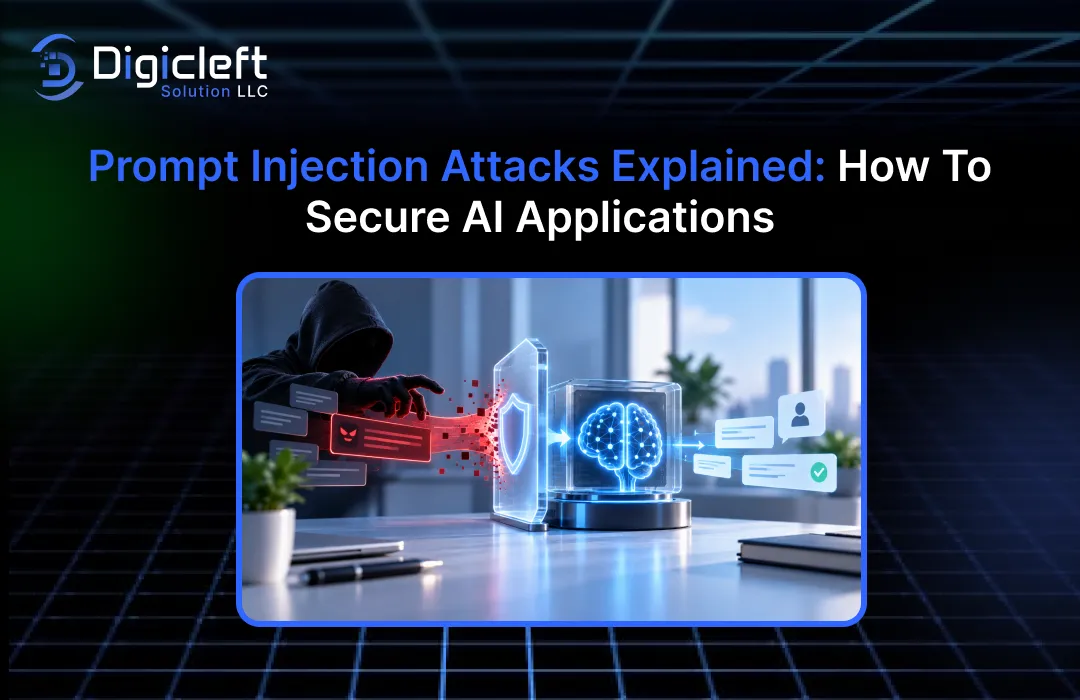
A simplified attack might look like this: a company develops an AI assistant that reads incoming emails and summarizes them.
An attacker sends an email that contains normal business text along with malicious instructions directed at the AI.The assistant retrieves the email, processes its content along with its trusted instructions, and produces a response that is influenced by the injected text.If the assistant is also connected to tools, databases, or external APIs without strong authorization controls, the manipulated output might trigger an action that the user never intended.The exact outcome depends on the system’s architecture, but the core weakness remains the same: untrusted content is allowed to influence a system with significant capabilities.
Common Prompt Injection Techniques
Attackers can use straightforward instructions, persuasive language, hidden text, encoding, unusual formatting, or other methods to influence an AI model.
OWASP’s prevention guidance specifically covers techniques involving direct instruction manipulation, remote or indirect content, encoding and obfuscation, and even typoglycemia-based variations designed to avoid simple keyword filters.
Instruction Override and Jailbreaking
The most well-known technique is instruction override, where the attacker tries to convince the model that earlier instructions are no longer applicable or that the model has been assigned a new role.
Jailbreaking is closely related and can be seen as a form of prompt injection in which the attacker attempts to bypass the model’s safety restrictions.OWASP distinguishes between these concepts while noting that they are often discussed together.
An attack does not necessarily need to be clear to a human.
Malicious instructions can be concealed within documents, websites, code notes, or other forms of content.Attackers may also use encoded data or unusual characters to try to avoid easy detection.OWASP’s current guidance highlights examples like Base64 encoding, hexadecimal encoding, Unicode-based attacks, and typoglycemia-based attacks.
This is why relying on a list of suspicious words is not sufficient.
Security measures must consider context, the source of the input, user permissions, intended actions, and potential consequences, instead of just searching for one specific phrase.
Why AI Agents Are More Vulnerable
A regular chatbot may just generate text.
But an AI agent can do much more.It might access a database, create a support request, send an email, update a customer relationship management record, invoke an API, carry out a workflow, or interact with other software.Once an AI system has these abilities, prompt injection is less about creating an odd sentence and more about influencing a system that can take real-world actions.Because of this, OWASP emphasizes limiting access to only what is necessary and requiring human confirmation for high-risk actions.
Permissions, APIs, and Extra Privileges
A strong security principle here is simple: give the AI only the rights it truly needs.
If an assistant only needs to view customer orders, it should not also have the ability to delete customers, issue refunds, change account permissions, or send emails without restrictions.Microsoft similarly advises using temporary permissions and human verification for risky actions when guarding against prompt injection.
Think of an AI agent like a new employee.
You wouldn’t give a new hire access to every part of the company on their first day.You’d grant them access to the systems needed for their job, monitor important activities, and require approval for sensitive decisions.The same approach should apply to AI agents.
What Can a Successful Attack Lead To?
The possible results can range from confusing responses to serious data breaches and operational risks.
OWASP lists outcomes such as leaking sensitive data, exposing system instructions, gaining unauthorized access to functions, executing commands through connected systems, altering content, and affecting important decisions.
The actual impact depends on how the application is built.
A public marketing chatbot with no private data may have a limited impact.However, an internal AI assistant connected to customer data, employee files, source code, financial systems, or email services can cause far greater damage.Therefore, security teams should not only ask, “Can the model be tricked?” but also, “What happens if the model is tricked?”
This shift is essential.
It’s nearly impossible to prevent all harmful inputs completely, and OWASP clearly states that there is no foolproof prevention method due to the nature of generative AI.A better strategy is to assume some attacks may succeed and build the surrounding application so that any compromised model cannot easily cause major harm.
How to Protect AI Applications from Prompt Injection
The strongest strategy is layered defense.
Relying on just one prompt, one filter, or one classifier is not enough.Combine multiple security measures so that if one layer fails, another can still limit the damage.Microsoft recommends using multiple types of defenses, while OWASP suggests combining instruction restrictions, validation, filtering, access control, content separation, human approval, and adversarial testing.
Implement Least-Privilege Access
Start with permissions.
Every AI tool should have the minimum access required to carry out its tasks.Where possible, separate reading from writing operations, limit API access, use application-level authorization, and avoid letting the model have direct control over sensitive credentials.The model should request an action through controlled application code instead of having unrestricted access to secrets or infrastructure.OWASP specifically recommends handling extensible features in code and restricting the model’s privileges to the minimum necessary.
Separate Instructions From Untrusted Data
External content should be clearly marked as untrusted data, not trustworthy instructions.
This is especially important for systems like RAG, web search agents, document assistants, email helpers, and coding tools.Microsoft recommends isolating untrusted data and creating strong boundaries between the model, external sources, and downstream functions.
Developers should also avoid putting secrets in prompts.
System prompts are instructions, not secure storage.OWASP advises against leaking system prompts and recommends keeping sensitive details like credentials and connection strings outside the prompt, relying instead on real authorization systems.
Add Validation, Guardrails, and Human Approval
Before an AI-generated result reaches a sensitive system, it should be validated.
If the model generates a database query, API request, email, financial transaction, or account change, the application code should check if the action is allowed.The model should not be the final decision-maker on whether it can perform an action.This is a key difference between a secure AI application and one that hopes the model behaves correctly.
Guardrails can also work in different stages.
Input controls can check user prompts and retrieved content.Model-based filters can spot suspicious behavior.Output controls can review the generated result before it goes to the user or a downstream tool.OWASP suggests using input and output filters and notes that model-based guardrails can support, but not replace, deterministic controls.
For high-risk actions, human approval is still important.
Sending an email, deleting data, changing permissions, approving a transaction, or sharing sensitive details shouldn’t happen just because an AI model generated a confident instruction.Both OWASP and Microsoft emphasize human-in-the-loop approval as a key defense for privileged actions.
Prompt Injection Testing and Monitoring
Security testing should happen both before and after deployment.
Developers can create test cases that try to manipulate instructions, extract sensitive information, influence tool calls, exploit indirect content, and bypass validation.OWASP recommends adversarial testing and attack simulations as part of defending against prompt injection.
Monitoring is also crucial.
Log relevant model interactions, tool calls, authorization decisions, rejected actions, suspicious retrieved content, and policy violations, while keeping privacy and data retention rules in mind.Microsoft notes that prompt abuse can be hard to detect because attackers use subtle language, and effective logging and telemetry can help find suspicious behavior sooner.
A mature security program should continuously test new models, prompts, tools, retrieval sources, and integrations.
Changing the model can change behavior.Adding a new tool can increase the risk.Connecting another data source can introduce new ways to inject indirect content.AI security, therefore, must be treated as an ongoing engineering discipline, not just a one-time task.
Building a Long-Term AI Security Strategy
A secure AI application starts with threat modeling.
Before launching an AI feature, identify what information the model can access, where it comes from, which parts are trusted, what tools the model can use, what those tools can do, and which actions need human approval.Imagine the model acting incorrectly or being manipulated and trace the potential consequences.Microsoft suggests designing for indirect prompt injection with the understanding that some attacks may succeed, rather than assuming all malicious input can be perfectly detected.
The goal is not to stop AI from doing useful work.
The goal is to set clear boundaries around its capabilities.A good architecture lets AI reason and assist while ensuring authorization, secrets, business rules, and irreversible actions are controlled by deterministic application systems.When AI is treated as an untrusted component, rather than an unquestionable authority, developers can build useful systems without giving language models limitless power.
How to Create: Engaging and Intuitive Websites for Maximum Impact
AI security should also affect how an AI-powered website is designed.
A secure application can still fail users if its interface makes permissions, automated actions, or data usage unclear.When an AI assistant wants to perform a sensitive action, the interface should clearly explain what is about to happen in language a normal user can understand.Instead of using a mysterious “Continue” button, the experience should identify the action, the affected data, the destination, and the consequences before asking for approval.
This is where thoughtful UX and security design work together.
Creating engaging and intuitive websites with maximum impact involves more than just visually appealing designs.
It’s crucial to ensure that the interface is easy to use and helps users understand security-related decisions.Users should be able to tell if the AI is accessing external data, using connected tools, or if they need to confirm an action.Clear messages, visible trust indicators, confirmation screens, control over permissions, and understandable error messages help prevent accidental approvals and make it easier to identify suspicious activity.
For businesses building websites that use AI, security should be considered from the beginning of the design process, rather than added later.
The best user experience isn’t always the one with the fewest steps.In some cases, an extra confirmation step can protect users from unintended actions or help prevent data leaks caused by AI.
The Role of Digicleft Solution in Secure AI Experiences
For companies exploring AI-powered digital products, Digicleft Solution emphasizes that digital experiences and security must develop together.
Whether creating an AI chatbot, an intelligent website, a customer-support assistant, an internal knowledge tool, or an autonomous workflow, the technology should align with actual business needs rather than simply adding an AI model to an existing interface.
This approach includes considering the entire user journey: what the user asks for, what information the AI pulls, which sources are reliable, what tools are available, which actions need approval, how the interface communicates risks, and how the business monitors unusual activity.
Prompt injection shows why AI security cannot be fully handled inside the model alone.The model is just one part of the system, so the surrounding product architecture, backend permissions, user experience, monitoring, and governance all need to work together.
Conclusion
Prompt injection attacks are a significant security challenge for modern AI applications, especially as businesses move from simple conversational tools to systems such as Retrieval-Augmented Generation (RAG), AI copilots, and autonomous agents.
The core issue is straightforward: untrusted content can affect an AI model intended to follow trusted instructions.When that model has access to private data or powerful tools, the consequences can be more severe than just an incorrect answer.OWASP’s 2025 guidance lists prompt injection as the top risk for LLM applications, while NIST defines the vulnerability around the combination of untrusted input and trusted prompts.
There isn’t one perfect prompt or a single magical security filter.
Instead, build multiple layers of defense: least-privilege permissions, strong authorization, separation of untrusted content from trusted instructions, validation of both inputs and outputs, guardrails, monitoring, adversarial testing, and human approval for high-risk actions.Most importantly, design the application assuming the model might be manipulated.If the system still prevents unauthorized access and dangerous actions in those situations, your AI application becomes significantly more resilient.
FAQs
1.What is prompt injection in AI?
Prompt injection is an attack where untrusted input tries to change an AI model’s intended behavior.
It can involve direct user prompts or hidden malicious instructions in external content such as webpages, files, emails, or other data sources.
2.Is prompt injection the same as jailbreaking?
They are closely related but not always the same.
Jailbreaking usually refers to bypassing an AI system’s safety measures, while prompt injection is a wider concept that involves altering model behavior through input.OWASP considers jailbreaking a form of prompt injection.
3.Can RAG prevent prompt injection attacks?
No.
RAG can enhance the relevance of data provided to an AI model, but the retrieved content might include harmful instructions.OWASP states that RAG and fine-tuning do not fully protect against prompt-injection vulnerabilities.
4.How can businesses protect AI agents from prompt injection?
Businesses should use a layered defense strategy.
Key measures include least-privilege permissions, strict application-level authorization, isolating untrusted content from trusted instructions, validating model outputs, monitoring tool usage, conducting adversarial testing, and requiring human approval for high-risk actions.
5.Should sensitive information be placed inside an AI system prompt?
No.
A system prompt shouldn’t be considered a secure storage method.OWASP recommends keeping credentials, connection strings, passwords, and other sensitive data outside of prompts and securing them through proper authorization and access controls.