
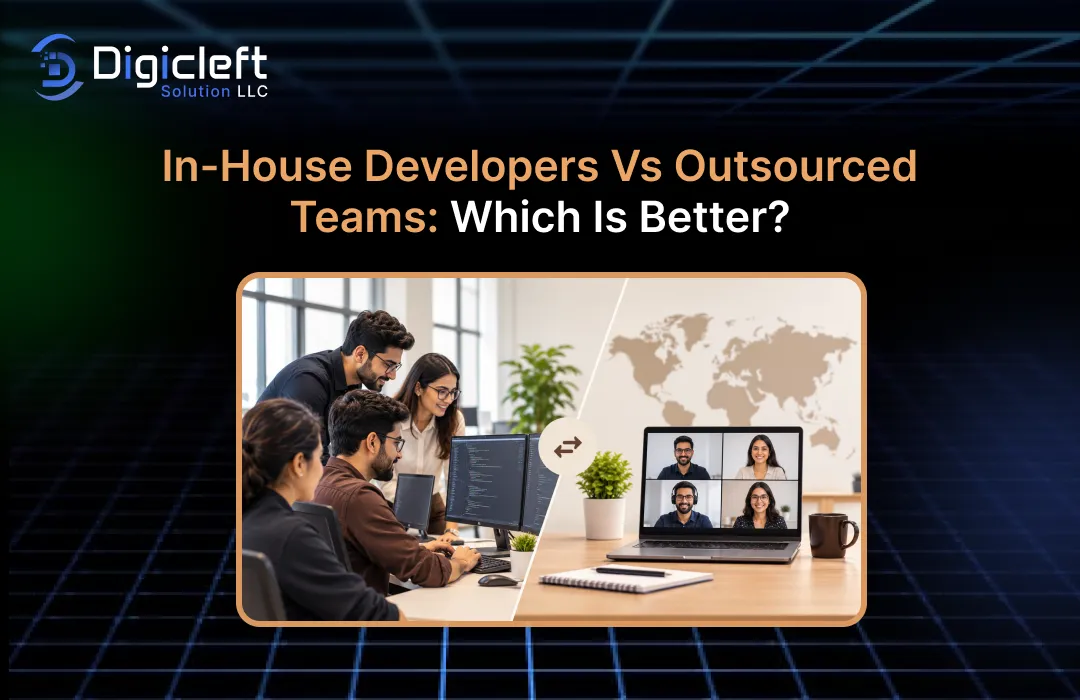
Introduction to In House Vs Outsourced Development
Selecting the right software developers is a crucial decision if you intend to develop a website, mobile application or custom software system. You may have the product idea, the business plan and funding in place. The one question you probably have right now is whether you should hire your own in-house developers or whether you should use an outsourced development team.
On the face of it hiring in house developers might look the safer option. You have in house developers who are working directly for your business, who know your business, who know what you want to do. They are there for the continuous discussions. Conversely outsourcing can give you the skilled and experienced personnel, the specialist technical skills, the development resources that you need on a flexible basis without creating an in house team.
It is not about the lowest price. It’s a question of the development cost, complexity of the project, the time limits, security demands, communication, and further support. Outsourcing might be the optimal solution for an innovative startup, while an established IT corporation is more likely to benefit from an internal engineering department.
Tech is evolving at an astronomical rate. The report points out the rise of AI agents in software development in the exciting new tech landscape that continues to evolve. Basically, it’s safe to say that now organisations need teams who are willing to work with that technology and not just teams of coders.
Now, let’s look at the differences and see which approach makes most sense for your business.
What is in-house software development?
In house software development means that you’re actually writing and maintaining the software using people who are directly employed by your company. All developers are integrated members of your team and cooperate very closely with other departments (management, marketing, design, sales, customer support etc.)
Suppose, for the sake of example, that you own an e-commerce business and wanted to develop a custom shopping app. You could just walk into the office, hire a front end dev, a back end dev, a UI/UX designer and a QA person to develop the app in house. Your in house devs would be the ones who would understand your business and who would slowly get to know your customers, your products and your way of doing things.
So this is very relevant when you are building some software to become part of your business. Instead of going to an out-sourced provider, your organization is still ultimately responsible for development choices, the technical infrastructure and the features.
But assemblinga team isin’t merely a matter of hiring somereaders. You need to consider pay, perks, recruiters, coaches, development tools, usage infrastructure, and long-term team operations… That’s all partof it…
Advantages of Hiring In-House Developers
- Communication: House builders can discuss the needs and overcome problems very quickly.
- In house developers allow your organisation to control the programme of works, what is prioritised and the technical direction of the project.
- In house developers stay with your organisation.
- Team work: personal interaction between in house developers, marketing, sales and the others within the organisation.
- It stays in your company through your people stay and your documentation stay.
Working with in-house developers: Cons
Whilst you stand to benefit from a dev team, there are issues that can arise from having one. Recruitment is usually the main issue. It may take some time to recruit the specialists with the necessary experience – such as AI, cyber security, cloud specialists.
But the money is still the issue. You have to pay your people whether you’re doing a lot of development work or just coming back from a break. If you’re on hold then you’re still paying them, still paying their benefits and still paying for the infrastructure.
And there is staffing. Say you lose a good, experienced developer. All the new knowledge that they have gained about your product and your company goes out the window. Then you must repeat that whole process again!
For a startup or small company with bandwidth, those roadblocks are a mountain of pressure even before the product hits the market.
What is outsourced software development?
Software development outsourcing means you hire a firm (company, agency, or set of people) to do some or all of the work for you.
You deal with an experienced vendor who already has a team of designers, developers, testers, project managers and technical support specialists.
Like say, if you’d like to launch an app but don’t have a dedicated internal engineer team, then you can team up with a software development firm for the entire process, from brainstorming to UI/UX designing, coding, testing, implementation, and servicing.
Outsourcing isn’t limited to projects. You could also outsource the development of your website, API integrations, cloud migration, software testing and the maintenance of your applications.
This feature is especially attractive when it comes to a company which has more tend to need high skills but does not want too hot stay an oversized full time staff.
How Outsourced Development Teams Work
An outsourced team will usually start by fully understanding what you want to achieve, your project goals, budget, and the time frame for delivery.
The provider then makes a recommendation for a development path and allocates the right people according to the technical needs of the projects.
The methods of communication are usually meetings, project management platforms, email and the different collaboration tools. The teams involved are either a fixed project team, dedicated dev team or individual specialists as agreed.
There are common outsourcing arrangements:
- Project based outsourcing: you outsource a specific project.
- A committed development team: throughout the project you work with a team that is committed to your business needs.
- Additional developers: hire outside developers to add to your team to close down skills gaps.
- Offshore outsourcing: you rent a development partner in a different country.
- Offshore outsourcing: similar to nearshore outsourcing but based on offshore locations.
It’s going to depend on how much control, flexibility and technical support your business needs.
Benefits of Outsourcing
The advantage is flexibility. You can access developers without the long lead time, which is required to establish a dedicated, internal team.
Suppose you’ve an app you’ve acquired with customer facing app with payment connected, cloud and an admin dashboard. You’ll be likely to locate that very pricey and also time eating out and employ specialists for all those places. A outsourcing business that is currently in presence would probably possess the individuals in house to do those things.
Outsourcing opens you up to the available talent pool. You don’t have to find a developer near you or one who is interested in coming to your location.
Additional advantages are:
- A single provider handles the recruitment and teaming.
- Accessibility to skills: you have the ability to collaborate with individuals who possess expertise in various technologies.
- Flexible resources: the size of our team is adaptable to make sure we have enough people to execute your project successfully.
- Life of Project Can be in place way before it would take to get an internal department up and running.
- Cost of the project: Fixed price or a dedicated team model will help plan the budget much more easily.
- Concentrate on the core functions: so that managers can focus on business expansion, instead of being bothered with all the techie stuffs.
If your company is looking to start up or develop a product but lacks the available staff and knowledge internally, outsourcing would be a good strategy to follow.
Limitations of Outsourcing
However outsourcing is another factor to consider. Your dev team may be working in a different location outside your organisation and you won’t have the same oversight.
Communication can easily go wrong when you have teams across time zones and or diverse working practices. A requirement can simply be interpreted differently by two teams and a requirement change consequently occur.
Vendor lock in another problem. For whatever reason a lot of providers have the technical documentation, the access to your infrastructure or the deployment of your app so tight that it is very hard to get someone new in.
Think about confidentiality, IP and data protection – until you have agreed what information you can and cannot share, it will be impossible to safely share any business information.
The key to successful outsourcing is having crystal clear responsibilities, expectations, deliverables and channels of communication from the very start.
InHouse Developers Vs. Outsourced Teams: The Significant Differences
Both are capable of delivering the software, but the manner in which the teams are managed, the way the resources are allocated and the manner in which the business deals with the long term development work is distinctly different.
Here is a list of comparison of differences.
| Vergleichsfaktor | Inhouse-Entwickler | Teams |
|---|---|---|
| Hiring | Company hires developers | Provider hires developers |
| Initial investment Often higher | Often lower | Often lower |
| Projektkontrol | Direkta kontrol within the company | Bertelle by agreements |
| Communication | Direct and internal | Online. Tools |
| Technical skill | Available within the company | Unique and hard to find among other candidates |
| Flexibility | Depends on hiring capacity | More straightforward to expand workforce |
| Speed of development | Easy to hire the team | Can begin earlier as team already available |
| Maintenance | Managed internally | Managed as per the Service contract |
| Security | policies and configuration | Requires security auditing by vendor |
| Longterm commitment | Permanent employment costs | Contract-based commitment |
| Knowledge Ownership | Kept within the company when written down | Requires adequate documentation and handover |
The major distinction is responsibility. Company in house teams are the ones handling the people and technology as well as the development work, whereas outsourced methods take responsibility for the work that’s agreed as well as the outcomes.
As shown in Clutch’s comparison of house versus outsource from September 2026, in house development supplies product expertise and manages the process whereas outsourcing gives you entry to specialist expertise and extra flexibility. The appropriate choice will not be necessarily the very same for each enterprise.
Cost Comparison: InHouse vs Outsourced Development
Business owners typically focus on cost when trying to decide between a build model. However, there can be a huge disconnect when comparing monthly developer salary or an agency quote.
In house development’s true price isn’t just the cost of salaries. You’ve got to add recruitment, benefits, office space, software licences, hardware and the overheads of management.
Outsourcing will usually remove many of these operating costs as the provider will already have their infrastructure and people. But you’ll still need to worry about project management, contract modifications, additional features, maintenance and potential communication.
Here is a comparison.
| Cost Factor | InHouse Development Outsourced Development* |
|---|---|
| Recruitment | Company handles recruitment cost |
| Monthly pay | Employee ongoing costs |
| Employee benefits | Required in general |
| Infrastructure | Company supplies equipment/tools |
| Training | Company manages training |
| Project management | Internal management required |
| Upkeep | Is the inside workforce accountable for updates? |
| Increasing costs | Hiring on the go |
What is the more economical model?
You can still find it more cost efficient to outsource when it’s just a short term project – you do not need to invest in employing someone to do the piece of work. You simply pay for the skills and services you need.
You can always use an in house team for long term software development – this would usually be cheaper if you’ve got some development work on which will keep the team busy.
Take another example. A startup working on its mobile app may not require a single full time engineer once it is launched. An existing software company constantly releasing new functionalities perhaps should consider having their own engineers.
It’s better to calculate the cost of ownership than compare job rates.
Which Model Delivers Superior Quality and Security?
Software quality isn’t about whether the developers are in the office or out of the office, whether they work for a provider or whether they’re in-house. Software quality is about what they can do, and how they do it.
A team from outsource can be successful if they do things the right way (to do good engineering). The same goes for an insource team that can produce working software if it only had some leadership, some good testing, and some clear requirements.
It needs to be given proper attention if the project involves money, personal customer information, confidential health records or business data.
Having in house developers gives you always control over access to systems, databases and dev environments. However, having an in house team does not at all reassure your security. You need secure coding practices, audits, restriction of access and vulnerability scanning.
Such teams can also be made secure. Security procedures of the company should be checked before providing such team.
Important precautions include:
- Sign confidentiality and non-disclosure agreements.
- Make it crystal clear who owns the intellectual property.
- Use role based access controls.
- Secure the source code repositories & the dev environments.
- Establish data-sharing procedures.
- Perform periodic code reviews and security testing.
- State who will be responsible for backups, incident reporting and maintenance.
Write the terms of your contract with complete clarity, especially regarding ownership of the source code, the designs, the documentation and other project deliverables.
My advice would be to retain control of your business email accounts, domains, source code repositories and even your cloud infrastructure where you are able to so that you don’t have to depend on anyone else.
Communication, Collaboration and Project Management
Even with a project development team and a very high budget, communication issues can cause failure.
You request a checkout enhancement on your eCommerce site. The feature that the people working on it understand it completely differently, develop it and then require a further week to refine it. The problem isn’t capability. The problem is communication.
In-house devs usually win in this regard because they can speak directly with the business. They can attend the meetings, get customer feedback, pick up the shifting priorities etc without being reliant on formal handovers.
Teams working remotely require a communication process. Not, however, that working remotely is anything to be afraid of. All it means is that there should be a process to follow on what gets communicated and the pattern in which decisions are made.
For project management, establish:
- Well defined project requirements (such as: features, functionality, technical scope and business goals) should be established in the first instance before any development work begins.
- Weekly status meetings: Meet every two weeks to discuss the work that has been done, the work to be done and if there are any problems.
- Tools to manage the project: each person can be assigned on Jira, trello, or any project management tool of your choice.
- Written documentation: keep the specification, meeting decisions, API documentation and the product guidelines.
- Established communication channels: determine where issues can be reported, where to send updates and where approval requests are to be made.
Ultimately, it’s not about tracking someone every second of the working day. It’s about ensuring the whole team is on the same page and working towards a common goal.
When should you hire in-house developers?
If your software is central to your competitive edge, having an in-house dev team is ideal.
For example, a SaaS company expanding its subscription platform will require developers who are familiar with the platform architecture, the customer needs, the integrations and the overall product vision.
In-house developers are especially beneficial when:
- Your business needs software development.
- You routinely update your apps.
- You deal with sensitive internal information.
- You require all your team members to be in touch with other teams.
- You wish to construct up that phrase specialized understanding in home.
- Your business are a budget for permanent technical employees.
Another major concern is ownership of the product. If you software contributes to your identity then having some knowledge in house will pay dividends in the end.
But then again you just want the full control that comes from not hiring a developer you don’t need the developer to do it. You do want some who can take care of the technical side, you do need the infrastructure and you do need a team of people.
When should you opt for an outsourced team?
You don’t want a whole work force in the office you need the knowledge then outsourced.
What if you’ve got a company that is going to be launching a new website and a new application for managing customers? If you employ front end devs, back end devs, designers, testers and project managers that’s going to turn into a pretty expensive project.
An outsourced team may be able to build those skills under one development partnership.
You can consider outsourcing if:
- You have a dev budget.
- You’ve got to get a project started within a specific period.
- Your internal team are technically unskilled.
- You’ll need development support.
- You want to put the idea through the test without committing to hiring permanent employees.
- Your business requires an increase in development team size
Another example of how outsourcing can be useful is when you are looking at upgrading your current application. Maybe you already have a team who is maintaining your app, and you might require some cloud professionals from outside to do the actual transferring.
In this case it provides you with the expertise, although your company did not need to employ the expert permanently as this was a one-off requirement.
Is a Hybrid Development Model a better option?
Here is one thing that most businesses totally overlook: you don’t have to choose just one.
A model where you extend your team with outsourced developers. You still make all the business decisions and we add some extra developer capacity to your core team.
Another example can be that you decide to keep the product manager, the technical lead and the business analyst in house, but outsource the front end development, the mobile app development, the software testing or the specialist cloud engineering.
This structure offers a compromise between control and freedom.
Development framework example
Your Business
Product ownership and business strategy
InHouse Team
- Product manager
- Technical lead
- Business analyst
Outsourced Team
- Developers
- UI/UX designers
- QA specialists
One Development Project
Shared delivery goals, quality standards and responsibilities
The internal group are handling the business priorities, the course of the product, and the technical aspects. The outward group are focused on the development tasks that were scheduled.
This may also be a good option for a growing company that requires additional capacity for growth but doesn’t want to, or can’t justify, employing someone permanently.
It also facilitates significantly easier scaling. If at some stage you have to go out and find developers to build a new product release you can just grow out your existing external team without having to go through the whole recruitment process.
Hybrid development, of course, does need accountability. Without something to keep internal and external developers synchronized, they may actually duplicate effort or make technology decisions that conflict.
How to Choose the Right Development Partner
Outsourcing If you’re opting for outsourcing then this is your first big decision. Not every development company has the skills, the way with words or the project management team to do this.
A company can easily produce a quote, but that is simply a way of saying to them: ‘here is our budget, what can you give us? You need to go deeper into the price. It means little if the company has the capacity to understand the needs of your organization and to effectively support it in the future.
Just a few things you should keep in mind:
1. Review the companys portfolio
Consider the projects, particularly ones that would be similar to the industry that you are in, or similar to your own specific requirements. Has this firm worked on the development of web sites, mobile apps, enterprise platforms or custom-written software of the type that you require?
2. Evaluate expertise
Inquire of the dev team the tools they work with and their reasoning. It will vary on your specific project but you’d probably want to have some knowledge of React, Angular, Node.js, Python, Flutter, cloud computing tools, API / database development.
3. Know the process
A good PD partner should be able to just tell you how they go about the planning, design, development, test, deployment and maintenance of the project. You should be able to understand what the actual process should be, not just the delivery date.
4. Verify your communication styles
Discover who will be overseeing your project, how often you’ll be receiving updates and which communication tools the team will be using. Having a single point of contact can really help to streamline the process.
5. Discuss ownership and maintenance
What to clarify before sealing a deal: source code, documentation, IP, support and maintenance post launch.
If you are any type of company who is building a website or custom application, the help of the tech partner like Digicleft Solutions LLC is way to connect your technical planning to your business needs.
The goal should go beyond just a bit of development. What you’re looking for is a solution that is effective, supporting your client and scalable enough to grow along with your business.
This is also when the concept behind ‘How to Create: Engaging and Intuitive Websites for Maximum Impact’ has relevance. You have to be more than just eye-catching to have a successful website. It must be navigable, not slow to load, responsive, functional, and have an experience that encourages the site visitor to do something.
Whether you take the team approach or choose an outsourced development partner, these should be integral parts of your website development plans.
Conclusion
So in house developers v teams? Which is better?
The short answer is that both can be extremely effective. It really depends on your budget, nature and technical requirements of your project, what resources you have and your end goal.
On the house developers your have full control, much improved internal teamwork and, naturally, the long term product expertise. They are what you go for if software development becomes an ongoing feature of your business.
Outsourced teams gives you flexibility, access to expertise and takes the pain out of recruitment. Great if you’re a startup, growing business or just don’t want to build a whole in house team to get your development project completed.
Then a hybrid model could be the best solution. Keep ownership of the product and major technical decisions in-house and outsource the rest of the work.
No, the best dev team isn’t necessarily the cheapest or the largest. The best dev team is the one that gets your business, delivers the software, communicates and helps you to succeed.
Choose your dev model wisely. Build expectations. It’s all about building technology that creates value for the customer.
Frequently Asked Questions (FAQs)
1. Is in house development the better option than outsourcing?
Not always. At home you have complete control, over time you learn the product know-how and collaborating internally is so much easier. Offshore you have access to skills and resource as flexible as you need, without the hassle of recruiting. Which one suits you best will depend on your budget, how you plan to sell it and your overall commercial aims.
2. Conclusion – is it cheaper to outsource software development than hire in house developers?
In the short term outsourcing could be cheaper as you won’t be paying salaries, insurance, recruitment or office space. The long term costs can vary depending on the size and scope of your project, the type of contract you’ve negotiated, what the ongoing maintenance costs are and how much development work the project needs.
3. What are the biggest risks of outsourcing software development?
The main risks are clearly communication, security, ill defined scope of project, third-party vendor dependence and IP issues. These can be overcome by the developer through the use of contracts, secured access, well documented project, consistent and ongoing status checks and management and scope ownership.
4. Can small businesses benefit from development teams?
Yes. Companies that require professional web sites, mobile applications or custom software but do not have or need a full-time development department should consider outsourcing. Outsourcing give them access to know-how and scale outsourced development resources with their budgets and needs.
5. What is the hybrid software development model?
Hybrid development model which is a combination of inhouse employees & freelancers: Inthis model of development, internal employees provide the high-level overview of the business requirements & product strategy & oversee the technical side of development tasks. The hybrid model provides business flexibility & control.